

Kyle Jones
Moderator
I have to say, I am definitely catching the timelapse bug. I usually don't have the patience to leave my camera untouched for hours, but when I do the results have been fun. I'm using the Panasonic S1RII which has a really nice timelapse exposure leveling feature that creates smooth transitions as the light changes during sunset. I did some practice runs from my home to dial in my process, and I'll probably describe that in a post on my website sometime soon. Short version: I use the automatic exposure leveling during sunset in aperture priority mode with a fixed ISO. This prevents the camera from ramping the ISO too quickly and gives me a nice sunset to deep twilight video. Once it reaches my final desired exposure time (10 seconds for this one) I stop the timelapse, turn off the exposure leveling, and switch to manual mode. From there I manually ramped the ISO up to 3200. I knew the clouds were coming in and that it would be hours before the Milky Way would appear so I didn't stick around for stars. I used LRTimelapse to assemble the frames and deflicker and Davinci Resolve to assemble the final video.
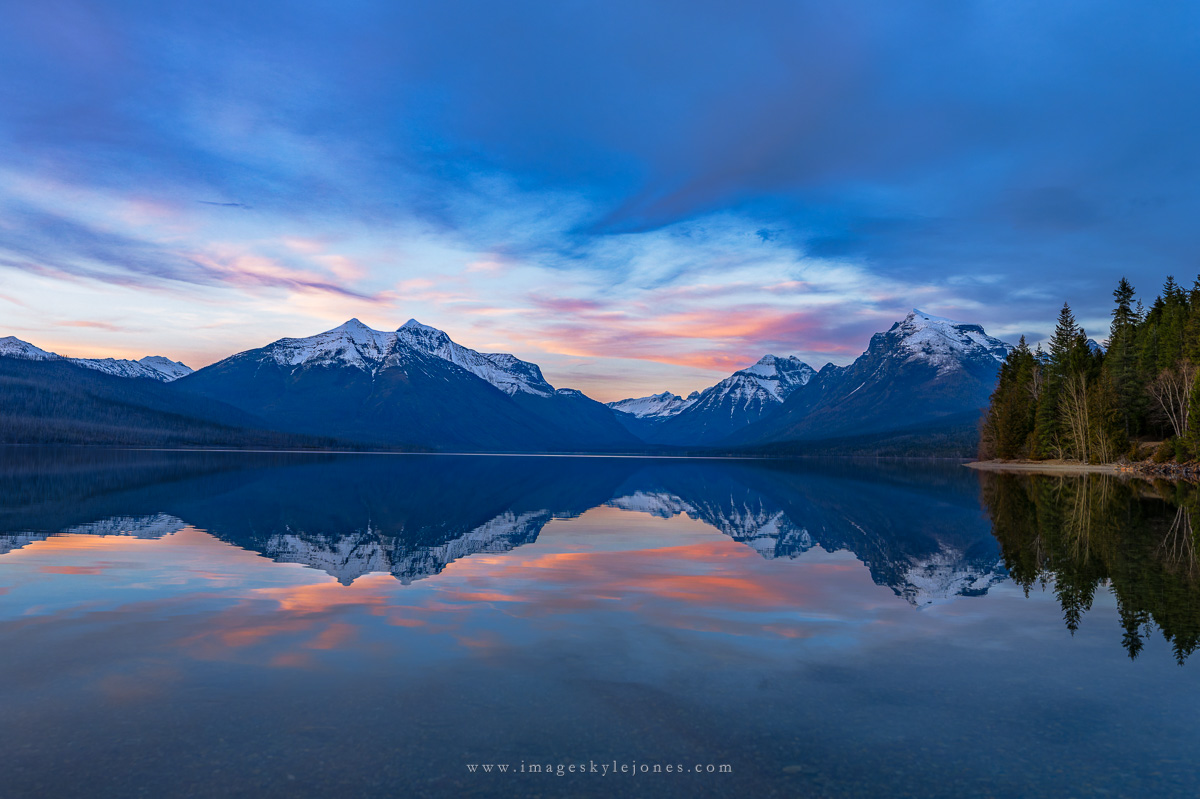
Enough about that... Here is my favorite frame during sunset.
And here is the video I assembled from that night at Lake McDonald along with a sunset looking toward the mountains from Whitefish to Glacier.
Enough about that... Here is my favorite frame during sunset.
And here is the video I assembled from that night at Lake McDonald along with a sunset looking toward the mountains from Whitefish to Glacier.


