

An interesting Poll Zeph, but I think you would need to repeat the first three options for the "You use an outside printer" or something to that effect. Because If I don't do my own printing, shouldn't' I still be able to choose the reason why I am getting something printed also?
You should be able to edit the poll and break #4 out into 3 separate questions also to mirror #1 to 3. If you can't let me know, I can edit it for you.
You should be able to edit the poll and break #4 out into 3 separate questions also to mirror #1 to 3. If you can't let me know, I can edit it for you.

For me, prints are the purpose of photography. So I have at least 1000 prints, most from my own printer. I wore out an Epson 3800 and now have an Epson P800. I am limited to 17 inches on the narrow width but none on the long side. So If I want bigger I have them printed outside. I am currently using Bay Photo to make large canvas wraps.
With prints you need to know more than how to print. You need to learn about frames, mats, maybe get mat cutting equipment, figure out where to buy the mats, how to coordinate the colors etc. You also need to know how to present them, lighting placement etc.
I soon ditched glass or plex covers because of reflections, even museum grade glass reflects. I also started with semi gloss, still too reflective, now I use fine art mat or canvas.
I have added LED color specific lighting that helps display the images in the same ambient light as I process.
I am still learning what I started in 2008.
With prints you need to know more than how to print. You need to learn about frames, mats, maybe get mat cutting equipment, figure out where to buy the mats, how to coordinate the colors etc. You also need to know how to present them, lighting placement etc.
I soon ditched glass or plex covers because of reflections, even museum grade glass reflects. I also started with semi gloss, still too reflective, now I use fine art mat or canvas.
I have added LED color specific lighting that helps display the images in the same ambient light as I process.
I am still learning what I started in 2008.

Darcy Grizzle
Well-Known Member
I don't print my own stuff myself, I have quite a few 24 x 36 canvas's some in my Vegas house & some at the cabin in Utah. The Utah ones are of images from Utah & the Vegas ones are mostly Wild Horses  . I do have a beautiful fall pic that I had printed on metallic paper 24.36 or so, and had it custom framed for the cabin. It was pretty pricey though, and the canvass I like just as much and at 1/2 the cost. I only have printed what I really really like of my work, as I don't have wall space LOL. I also have stuff printed for family.
. I do have a beautiful fall pic that I had printed on metallic paper 24.36 or so, and had it custom framed for the cabin. It was pretty pricey though, and the canvass I like just as much and at 1/2 the cost. I only have printed what I really really like of my work, as I don't have wall space LOL. I also have stuff printed for family.
Kyle Jones
Moderator
I send mine out. Every once in a while I consider buying a nice printer but I don't have a lot of space in my home for it. Considering the fact that Bay Photo is local to me, I essentially get next day prints from them without having to expedite anything. I'd have to print a lot to make it worth the financial investment.
I definitely agree that the proof is in the printing for photography. I regularly get my favorite shots printed 8x12 and hang them in my office so I can make sure I can produce excellent quality for people that buy prints and also so I can sit and stare at some nice scenes sometimes.
I definitely agree that the proof is in the printing for photography. I regularly get my favorite shots printed 8x12 and hang them in my office so I can make sure I can produce excellent quality for people that buy prints and also so I can sit and stare at some nice scenes sometimes.

MonikaC
Well-Known Member
I print on an Epson R3000, which limits me to 19" on the long side (unless I do a pano, then it's something like 38x19". I use the home prints to find all kinds of things I miss on the monitor (even at 100%) and to hang on the walls at the office to live with for some months to be able to really judge them. That was heavily advocated by David duChemin, & I find it really useful. Because of the emotional attachments I may think something is quite a bit better than I think 3- 6 months later. Sometimes patients want to buy one of the prints that I have up (so that's where the "print for resale" comes in. I do calendars at the end of the year, but I send those out. I found an attractive, inexpensive hanging system that allows me to change out prints in about 30 seconds, so I don't have the expense of framing or matting.

AlanLichty
Moderator
I used to print my own and still have an Epson 2880 sitting in my office but I don't print often enough to keep fresh ink ready to go in the printer and end up wasting far too much in maintenance to make it worthwhile. ProPhoto Supply Labs in Portland has done an outstanding job for me to date in making large prints and the price has been low enough for me to consider listing my 2880 on fleaBay with what's left of my ink. I do have a mat cutter and a clue how to use it. I have been buying mat and foam core backing online and also have online sources for frames.
This is a good point, I never bought a print I liked until I started printing at home and learned how to process them for print. Monitor calibration, ambient light, getting used to the way prints are always darker than displayed on a monitor. Getting used to a print that is on your wall for a while is also important.I print on an Epson R3000, which limits me to 19" on the long side (unless I do a pano, then it's something like 38x19". I use the home prints to find all kinds of things I miss on the monitor (even at 100%) and to hang on the walls at the office to live with for some months to be able to really judge them. That was heavily advocated by David duChemin, & I find it really useful. Because of the emotional attachments I may think something is quite a bit better than I think 3- 6 months later. Sometimes patients want to buy one of the prints that I have up (so that's where the "print for resale" comes in. I do calendars at the end of the year, but I send those out. I found an attractive, inexpensive hanging system that allows me to change out prints in about 30 seconds, so I don't have the expense of framing or matting.

Zeph
Well-Known Member
Hey Ben - I'm in total agreement with printing is the ultimate test of one's ability to manage the digital workflow. When it comes to being a proficient photographer, passing the print test is almost exiting as taking the shot in the first place.For me, prints are the purpose of photography. So I have at least 1000 prints, most from my own printer. I wore out an Epson 3800 and now have an Epson P800. I am limited to 17 inches on the narrow width but none on the long side. So If I want bigger I have them printed outside. I am currently using Bay Photo to make large canvas wraps.
With prints you need to know more than how to print. You need to learn about frames, mats, maybe get mat cutting equipment, figure out where to buy the mats, how to coordinate the colors etc. You also need to know how to present them, lighting placement etc.
I soon ditched glass or plex covers because of reflections, even museum grade glass reflects. I also started with semi gloss, still too reflective, now I use fine art mat or canvas.
I have added LED color specific lighting that helps display the images in the same ambient light as I process.
I am still learning what I started in 2008.
It all comes with a high cost, whether using a lab or one's own printer, trial and error is a good teacher $
Thanks for sharing where your at...
Zeph
Well-Known Member
Kyle - I've found that, as an amateur, having a working relationship with a the lab makes a big difference, when it come to wysiwyg. Having the lab near by is totally handy, they are usually pros and there is so much to be learned. Having small proofs is a good workflow with giving your customers the best output you can.I send mine out. Every once in a while I consider buying a nice printer but I don't have a lot of space in my home for it. Considering the fact that Bay Photo is local to me, I essentially get next day prints from them without having to expedite anything. I'd have to print a lot to make it worth the financial investment.
I definitely agree that the proof is in the printing for photography. I regularly get my favorite shots printed 8x12 and hang them in my office so I can make sure I can produce excellent quality for people that buy prints and also so I can sit and stare at some nice scenes sometimes.

Jeffrey
Well-Known Member
Like Ben, printing is my main goal in photography. I've done it since the first decent home printers became available, probably the Epson Stylus models from the early nineties. I've used an Epson 4800 for around 10 or more years now and it has finally started to give up. I'm receiving my new Epson Surecolor P5000 this week. I also have a framing studio at home where I mat and finish frame my pieces for display, galleries, or gifts. I do everything there except construct the wooden frames, which I have done locally for me. When I need larger sizes than my printer will make, I use a local fine art printer that I know and trust. A lot of my work has been exhibited in galleries and other places from eateries to banks to night clubs, in addition to having many on permanent display in hospitals and offices. I remember after years of study with my main mentor who was a darkroom guy, and having him tirelessly critique my work and digital prints, he finally proclaimed that my digital B&W's were as good as any darkroom results he has seen. Damn, that was a good moment.

Jim Dockery
Well-Known Member
I've been printing since I was shooting black and white for the HS yearbook back in the 70s (documentary not art). When I was working for DODS in Germany in the 80s I was lucky to have a wonderful color darkroom pretty much all to myself for a few years on the army base where I was stationed. It had a brand new Leica enlarger and jobo developing system so I got into Cibachrome printing up to 16x20. All of the print work had to be done in total darkness, and some of my prints took many minutes to expose, then about 20 min. to develope, so it was pretty exciting to open the developing tube (after carefully pouring out the noxious chemicals) and seeing how it came out. The high when it was just what I wanted was incredible.
I was very happy to leave the chemical darkroom behind (in fact I didn't shoot many photos at all for a few years while a buddy and I worked on a project to make a video of climbing and skiing all the volcanoes in the Cascade range back in the early 90s). When I started getting back into photography I wanted to print so got an Epson 2200, which worked well. When I retired I went whole hog and invested in a 7900 that was on sale at the time. I was hoping to sell prints as a second career, and have do so, but not enough to cover my costs. The 7900 creates fantastic prints, but like most users I'm now struggling with clogged print heads, which seem inevitable if you aren't printing every day, so I wouldn't recommend this unit.
I love the way my pictures look on my computer screen, or a good quality HD TV screen (my computer is hooked up to my 55" Panasonic for slide shows) but the artist in me finds final fulfillment when I hold a finished work in my hands (framed and matted).
I was very happy to leave the chemical darkroom behind (in fact I didn't shoot many photos at all for a few years while a buddy and I worked on a project to make a video of climbing and skiing all the volcanoes in the Cascade range back in the early 90s). When I started getting back into photography I wanted to print so got an Epson 2200, which worked well. When I retired I went whole hog and invested in a 7900 that was on sale at the time. I was hoping to sell prints as a second career, and have do so, but not enough to cover my costs. The 7900 creates fantastic prints, but like most users I'm now struggling with clogged print heads, which seem inevitable if you aren't printing every day, so I wouldn't recommend this unit.
I love the way my pictures look on my computer screen, or a good quality HD TV screen (my computer is hooked up to my 55" Panasonic for slide shows) but the artist in me finds final fulfillment when I hold a finished work in my hands (framed and matted).

Shibu George
Well-Known Member
I print at home just to display at my office, all the prints I sell are printed at some pro print shops. I'm still exploring different papers, Fuji Luster, Fuji pearl and Kodak Metallic. Do any of you have a preference on any of these papers for landscape prints?
I use Canson photographique Rag 310 exclusively. I started with some semi gloss from Red River, then went to their matte papers, but had some curling issues. Then I went to a heavier Hannemule rag before settling on Canson. I use 17 inch roll paper for everything now that I have a dedicated roll feeder. Its cheaper and avoids paper loading so often. I even print small stuff on roll. Just have to save up a few prints and use Qimage to make pages with multi up prints.

Sunny Sra
Well-Known Member
I mostly shoot to print...before i used to shoot to share...i find this to be more relaxing. During the shoot most of the times i decide "oh this would look good on this type of paper"
Majority of my prints are on Epson luster and metallic from redrock/hahnemule/epson.
I do my own printing, instant gratification. if i need something larger like 40x60 etc, then i send it in.
Majority of my prints are on Epson luster and metallic from redrock/hahnemule/epson.
I do my own printing, instant gratification. if i need something larger like 40x60 etc, then i send it in.

Doug P
Well-Known Member
I mostly print for gallery and shows. I use an Epson 3880 which limits me to 17 inches wide, however it seems most of the people buying matted prints are in this area. Either a 16x24 matted to 20x28 or a 12x18 matted to 18x24.
For website printing I use a small lab in Austin called Syline Art Prints, and Neil and his staff are wonderful. For metal that I have done or canvas that all seem to be larger (20x30 or larger) I use Bay like a lot of folks if it is not a website sale.
The key to a good print is making sure that you profile for the paper you are printing to and calibrate your display. For this I use the Spyder 5 monitor calibration (since I have dual monitors i had to move beyond the 4) and Spyder print for paper calibration. I also let Bay do color correction on my metals as they correct for that specific medium. Never use to until they convinced me to try, and now I will never submit a metal print to them without. Just sayin'.
When I first started printing I really liked matte paper from Epson or Red River. for the deep blacks I have since settled on Red River Ultrapro Satin 4 as I still get good blacks and the texture is light but minimizes reflections.
For black and white I print on matte and watercolor paper. I love the look of watercolor paper especially for winter scenes where the majority of the scene is white so the texture adds to it and always when printing a hikey image. This is if I print myself or send it to a lab.
For website printing I use a small lab in Austin called Syline Art Prints, and Neil and his staff are wonderful. For metal that I have done or canvas that all seem to be larger (20x30 or larger) I use Bay like a lot of folks if it is not a website sale.
The key to a good print is making sure that you profile for the paper you are printing to and calibrate your display. For this I use the Spyder 5 monitor calibration (since I have dual monitors i had to move beyond the 4) and Spyder print for paper calibration. I also let Bay do color correction on my metals as they correct for that specific medium. Never use to until they convinced me to try, and now I will never submit a metal print to them without. Just sayin'.
When I first started printing I really liked matte paper from Epson or Red River. for the deep blacks I have since settled on Red River Ultrapro Satin 4 as I still get good blacks and the texture is light but minimizes reflections.
For black and white I print on matte and watercolor paper. I love the look of watercolor paper especially for winter scenes where the majority of the scene is white so the texture adds to it and always when printing a hikey image. This is if I print myself or send it to a lab.

Timmeh
Well-Known Member
I've been printing on a Canon Pro 2000 (24 inch) for about a year and a half, and I do it the majority of time for sales made at art festivals (our walls have a large number of prints on them as well). I find printing myself much more satisfying than sending it off to Bay Photo, though fine tuning can be frustrating.
I use Ilford Gallerie Smooth Pearl and I haven't experimented too much with other papers. The whiteness of the paper and lack of brighteners that will yellow with time factor heavily into that. It takes saturation pretty well, though I do need to crank saturation much more than what looks reasonable in order to get the result. I might experiment with some matte papers later.
I'm also passable at matting and framing at this point, though its an expensive and space intensive habit. Camera to framed is my goal though for customers I rarely frame.
Tim
I use Ilford Gallerie Smooth Pearl and I haven't experimented too much with other papers. The whiteness of the paper and lack of brighteners that will yellow with time factor heavily into that. It takes saturation pretty well, though I do need to crank saturation much more than what looks reasonable in order to get the result. I might experiment with some matte papers later.
I'm also passable at matting and framing at this point, though its an expensive and space intensive habit. Camera to framed is my goal though for customers I rarely frame.
Tim

Jim Sanderson
Well-Known Member
I’m on my second HP Z3200. I sell through s local shop occasionally, but print for myself and others more often than not. I’ve always kinda thought that the finished print is the point of taking photos in the first place. And there’s nothing like a 40X60” print that turns out nice.

Dave Renfroe
Well-Known Member
(.... not sure this conversation is still active.)
I enjoy printing my own ..... but ..... have gone through many Canon printers and a lot of ink and paper experimenting on getting it to look good. I have not gone the "professional" large format printer route though - mostly 8.5x11 max. I have had no end of head clogging problems as we are snowbirds that travel for a few months every year. Now I have finally got a printer that produces really good results (and doesn't clog) -a 6 color Canon "MegaTank"G630. I am sticking with Canon inks and paper.
I print for our home use and gifts for friends and family. I have been mounting prints on painted cradle wood panels. I use a quality artist adhesive and then seal them with polyurethane medium similar to Mod-Podge. Its easy to do and looks casually good IMHO. (.... sorry for the rough photo.)
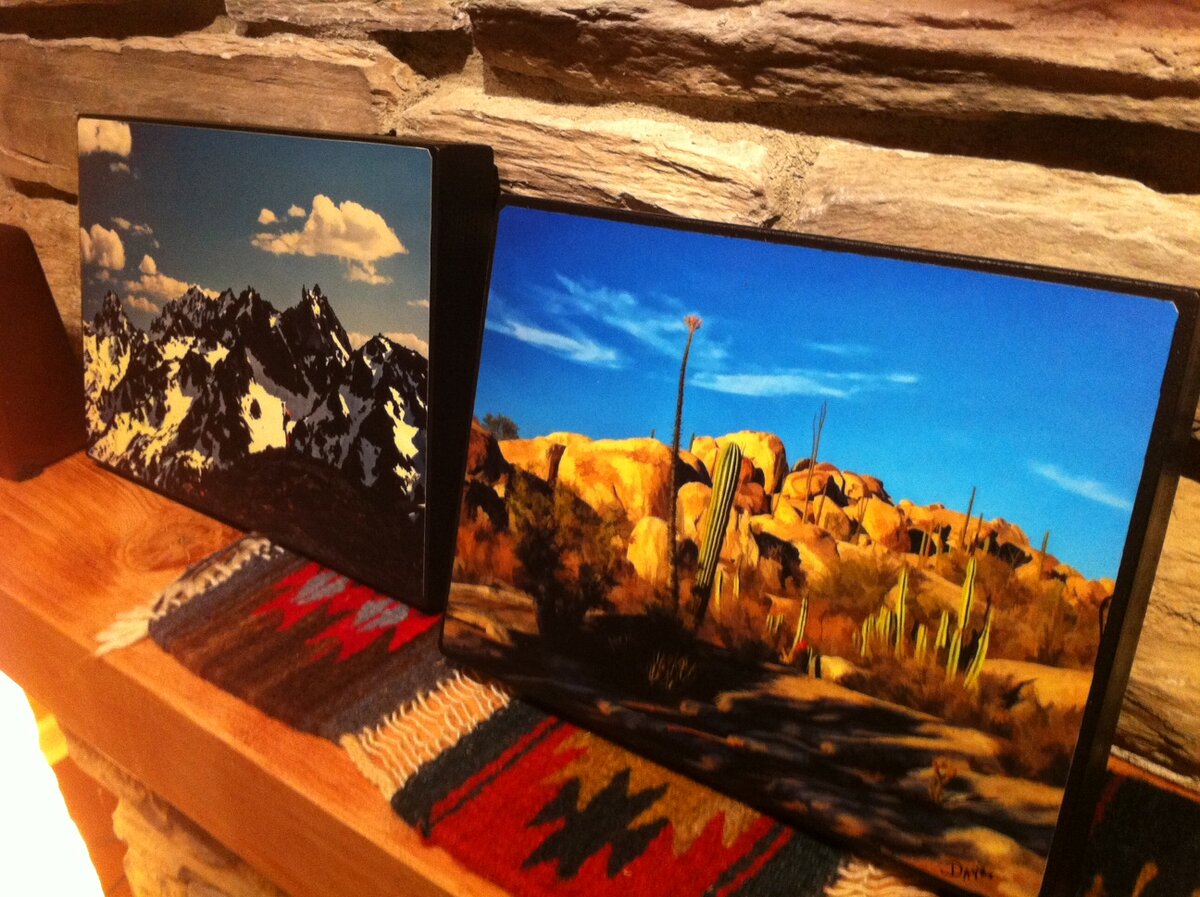
I enjoy printing my own ..... but ..... have gone through many Canon printers and a lot of ink and paper experimenting on getting it to look good. I have not gone the "professional" large format printer route though - mostly 8.5x11 max. I have had no end of head clogging problems as we are snowbirds that travel for a few months every year. Now I have finally got a printer that produces really good results (and doesn't clog) -a 6 color Canon "MegaTank"G630. I am sticking with Canon inks and paper.
I print for our home use and gifts for friends and family. I have been mounting prints on painted cradle wood panels. I use a quality artist adhesive and then seal them with polyurethane medium similar to Mod-Podge. Its easy to do and looks casually good IMHO. (.... sorry for the rough photo.)
Last edited:
AlanLichty
Moderator
You dug up an oldie for sure with this thread Dave. I honestly haven't printed a thing since my initial comments above 7 years ago and have simply been posted my work online. If you have a receptive audience for your work in print I'd certainly say Go for it.
I do have some prints on some walls in my house and keep thinking about adding/replacing some of them but never quite get around to it
I do have some prints on some walls in my house and keep thinking about adding/replacing some of them but never quite get around to it