

Bill Richards
Well-Known Member
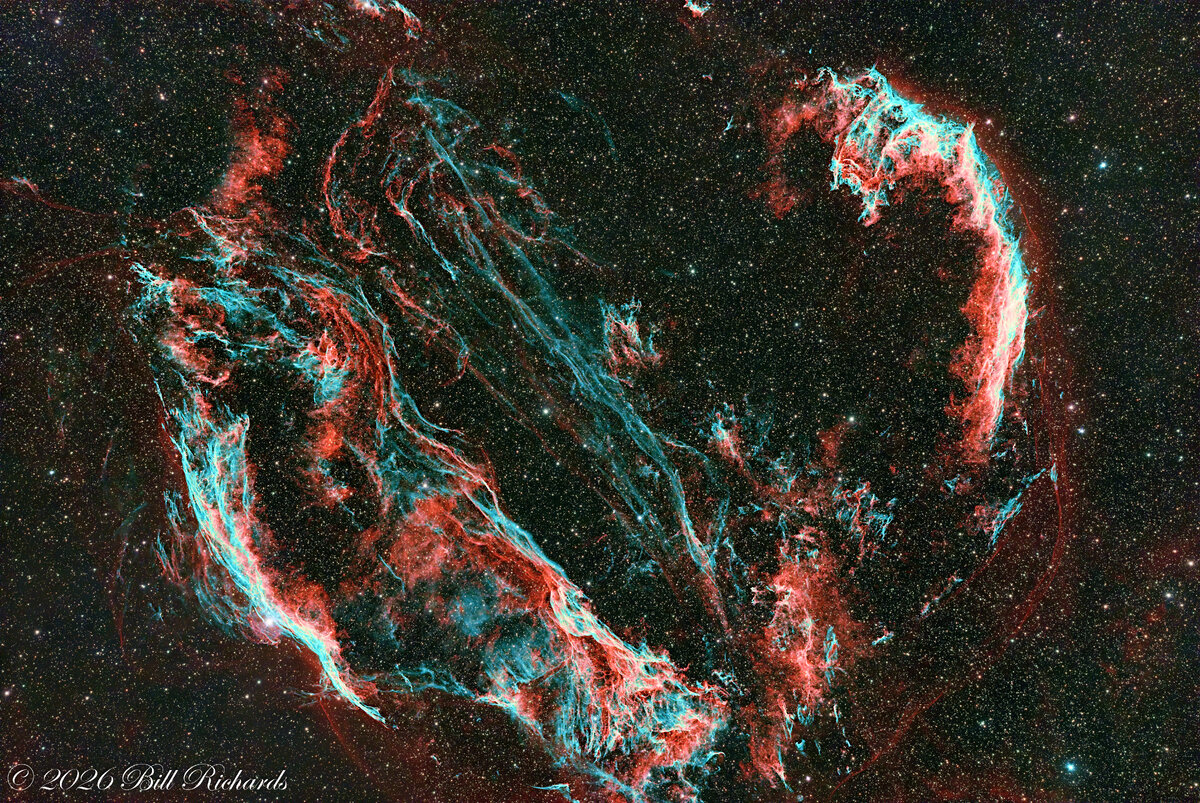
The "Veil Nebula" is a cloud of heated and ionized gas and dust left over from a massive supernova that occurred about 8,000 years ago when a star 20 times more massive than the Sun and ~2,100 light-years away ended its life in a spectacular explosion. The event would have appeared brighter than Venus and visible during the day. The remnants have since expanded to 110 light-years across, covering an area as wide as 6 full moons in the sky as seen from Earth.
In this image there's a ring of ionized gas centered between the two halves (oriented diagonally). One can envision the supernova blasting out a ring of matter from the equator of the star and the two veils from the polar regions.
This is the result of over 8.3 hours of exposure time taken on 2021-08-08 and 2026-06-16.
And the starless version, which is also pretty cool looking:

Equipment and Software:
=======================
Mounts: iOptron CEM40 w/iPolar and 10Micron GM1000HPS w/PoleMaster
Telescope: SkyWatcher Esprit 100ED at 360mm
Auto-Focuser: Pegasus FocusCube2
Imaging Cameras: ASI2600MC-Pro and ASI2600MC-Duo
Filters: Optolong L-eXtreme and Optolong L-Ultimate dual-band
Guide Camera: ASI290MM-Mini on OAG
Imaging S/W: NINA
Guiding S/W: PHD2
Image Processing S/W: PixInsight
Exposure Details:
=================
Camera Temperature -15C
Bias: 50
Gain: 100
100 x 300s
Plus 32x Darks, Flats, and Dark Flats
#VeilNebula #amateurastrophotography #asi2600mc #asiweek #astronomy #astronomyphotography #astronomypicturesdaily #astrophotography #cosmos #deepsky #deepskyobject #longexposure #nebula #nightphotography #nightsky #outerspace #photography #science #space #spacephotography #stargazing #stars #telescope #universe
In this image there's a ring of ionized gas centered between the two halves (oriented diagonally). One can envision the supernova blasting out a ring of matter from the equator of the star and the two veils from the polar regions.
This is the result of over 8.3 hours of exposure time taken on 2021-08-08 and 2026-06-16.
And the starless version, which is also pretty cool looking:
Equipment and Software:
=======================
Mounts: iOptron CEM40 w/iPolar and 10Micron GM1000HPS w/PoleMaster
Telescope: SkyWatcher Esprit 100ED at 360mm
Auto-Focuser: Pegasus FocusCube2
Imaging Cameras: ASI2600MC-Pro and ASI2600MC-Duo
Filters: Optolong L-eXtreme and Optolong L-Ultimate dual-band
Guide Camera: ASI290MM-Mini on OAG
Imaging S/W: NINA
Guiding S/W: PHD2
Image Processing S/W: PixInsight
Exposure Details:
=================
Camera Temperature -15C
Bias: 50
Gain: 100
100 x 300s
Plus 32x Darks, Flats, and Dark Flats
#VeilNebula #amateurastrophotography #asi2600mc #asiweek #astronomy #astronomyphotography #astronomypicturesdaily #astrophotography #cosmos #deepsky #deepskyobject #longexposure #nebula #nightphotography #nightsky #outerspace #photography #science #space #spacephotography #stargazing #stars #telescope #universe