Colorado CJ
Well-Known Member
The Cygnus Wall
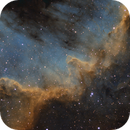
Here's a short section of the Cygnus Wall I imaged last night. I am really liking shooting narrow band targets. They can be shot on a bright moonlit night with almost no degradation compared to LRGB and work great in my light polluted (Bortle 7) skies.
18, 300 sec Ha images
18, 300 sec OIII Images
18, 300 sec SII Images
Stacked with Astro Pixel Processor, then combined and edited in Photoshop.

Here's a short section of the Cygnus Wall I imaged last night. I am really liking shooting narrow band targets. They can be shot on a bright moonlit night with almost no degradation compared to LRGB and work great in my light polluted (Bortle 7) skies.
This was shot using my Skywatcher MN190 and ZWO ASI183mm Pro camera.Sometimes, stars form in walls -- bright walls of interstellar gas. In this vivid skyscape, stars are forming in the W-shaped ridge of emission known as the Cygnus Wall. Part of a larger emission nebula with a distinctive outline popularly called The North America Nebula, the cosmic ridge spans about 20 light-years. Constructed using narrowband data to highlight the telltale reddish glow from ionized hydrogen atoms recombining with electrons, the image mosaic follows an ionization front with fine details of dark, dusty forms in silhouette. Sculpted by energetic radiation from the region's young, hot, massive stars, the dark shapes inhabiting the view are clouds of cool gas and dust with stars likely forming within. The North America Nebula itself, NGC 7000, is about 1,500 light-years away.
18, 300 sec Ha images
18, 300 sec OIII Images
18, 300 sec SII Images
Stacked with Astro Pixel Processor, then combined and edited in Photoshop.
Last edited: