

Dave Johnston
Well-Known Member
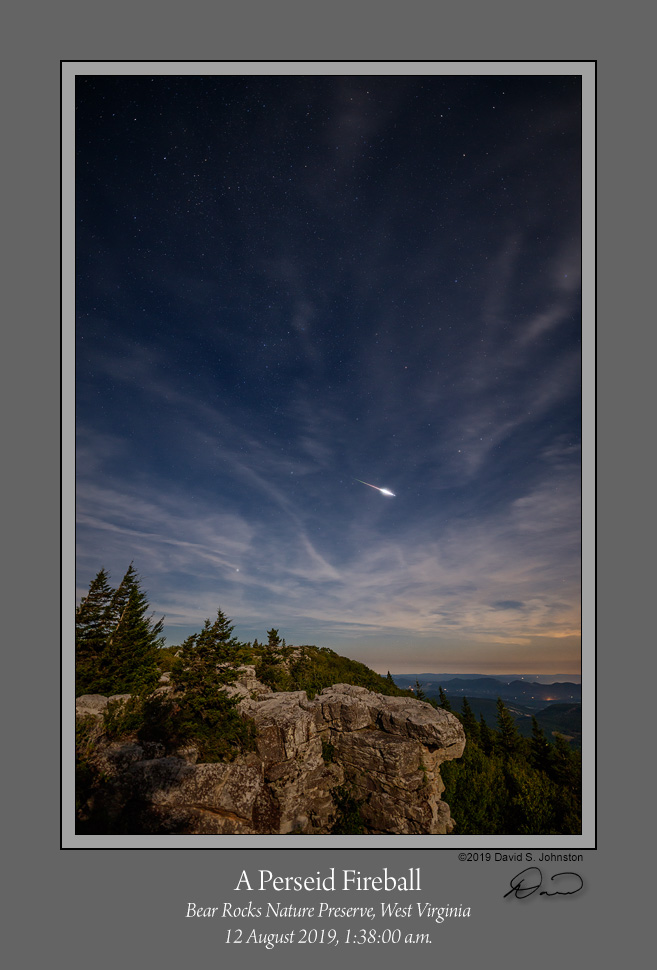
Observing this year's Perseids was challenging in West Virginia, with moonlight illuminating persistent high cirrus clouds. Not expecting much, I headed out and spent the Sunday/Monday night on a cliff edge hoping to get something. I let the camera run with continuous exposures from 5 seconds to 15 seconds (after the moon went down) and accumulated 2200 exposures, about 10 of which showed meteors, most of which did not show well through the thin clouds.
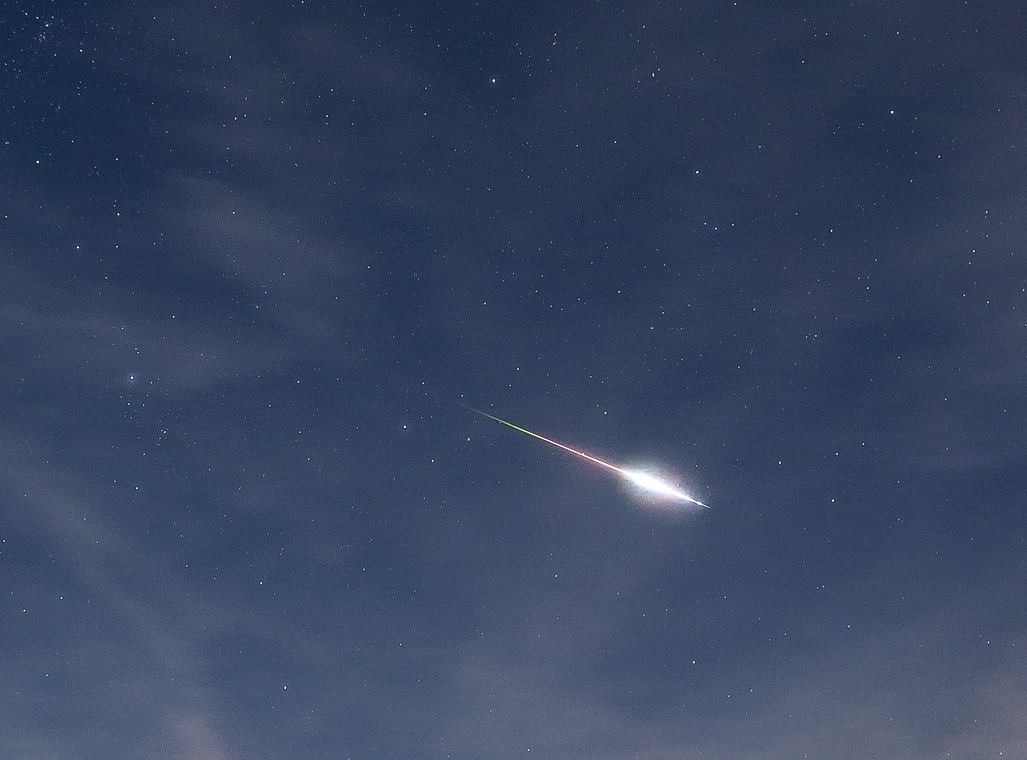
But I did get one good one, which qualifies as a fireball (magnitude brighter then -4). This was very short and fast, but it apparently exploded in a bright flash at the end. The cliffs in the foreground were illuminated only by moonlight. I darkened the sky a little for better contrast but otherwise this needed very little processing.
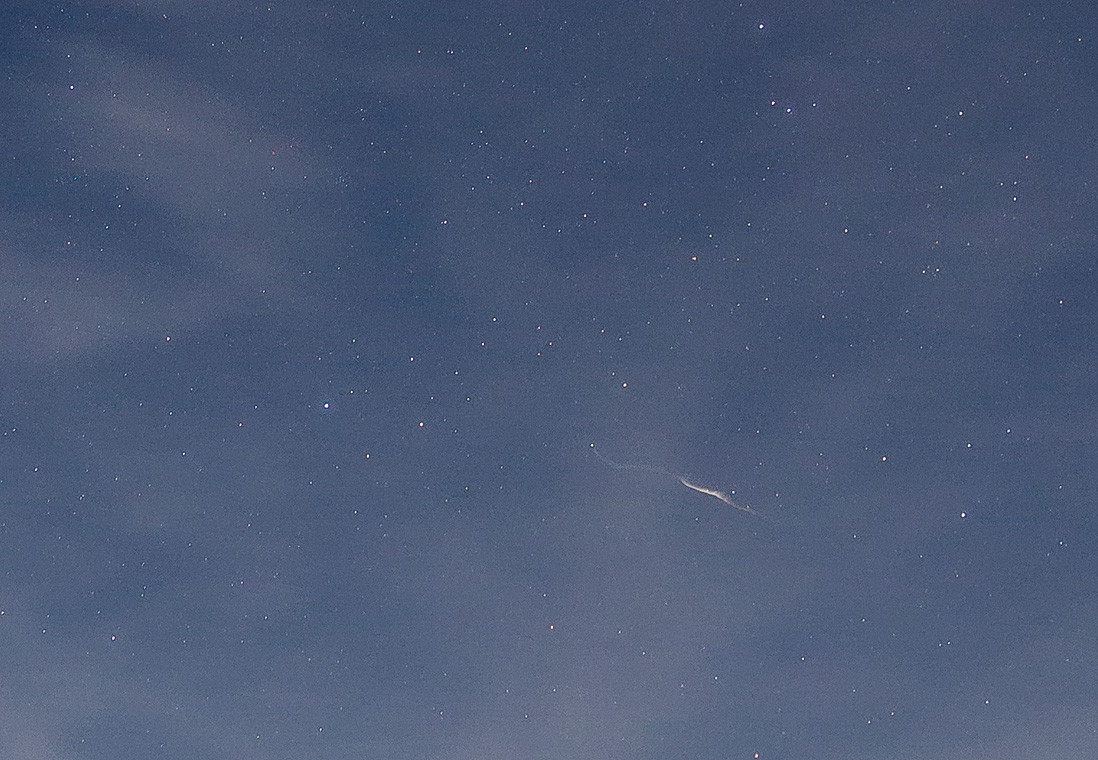
I'm including a detail of the meteor itself, and of the train that was visible for at least 30 seconds after the event. The train is composed of ionized, glowing air molecules, and was blown around by upper atmosphere winds.
Comments and suggestions are welcome!
Dave
But I did get one good one, which qualifies as a fireball (magnitude brighter then -4). This was very short and fast, but it apparently exploded in a bright flash at the end. The cliffs in the foreground were illuminated only by moonlight. I darkened the sky a little for better contrast but otherwise this needed very little processing.
I'm including a detail of the meteor itself, and of the train that was visible for at least 30 seconds after the event. The train is composed of ionized, glowing air molecules, and was blown around by upper atmosphere winds.
Comments and suggestions are welcome!
Dave


