

kiwiapple
Well-Known Member
When my mom and dad were relatively newly married and money was tight, my father returned from a business trip to Italy with the nicest gift for my mother that he thought he could afford--a pair of handmaid yellow gloves from Florence. What he hadn't counted on, unfortunately, was that you don't simply add yellow gloves to your wardrobe and that's it--you need a matching hat, purse and shoes to go with them, so of course my mother went out and bought all those things, making this relatively minor purchase really add up in cost.
A similar thing has happened to me. I bought myself a rotator to go with my refractor, thinking that would be that. But no--the rotator required an additional USB port that my ASIAIR didn't have, and attempts to use a splitter were not very successful. That led me to buy a powered hub that not only would give me more USB ports, but also could control power output to my devices. But that wasn't compatible with the ASIAIR so I faced the decision that I had long been putting off--learning how to use NINA to control my imaging sessions.
NINA is free, and it's powerful, but it is NOT user-friendly, at least not to start out. It has so many modules and panels that it just looks like the cockpit of a 747 compared with the ASIAIR's much more limited interface. But whereas the ASIAIR ties you into the ZWO ecosystem, NINA lets you use whatever you like, which is a big plus (and when we eventually make it into our new house, I'll have a dome on my observatory that only NINA can control, which is why I knew I'd have to learn to use it eventually).
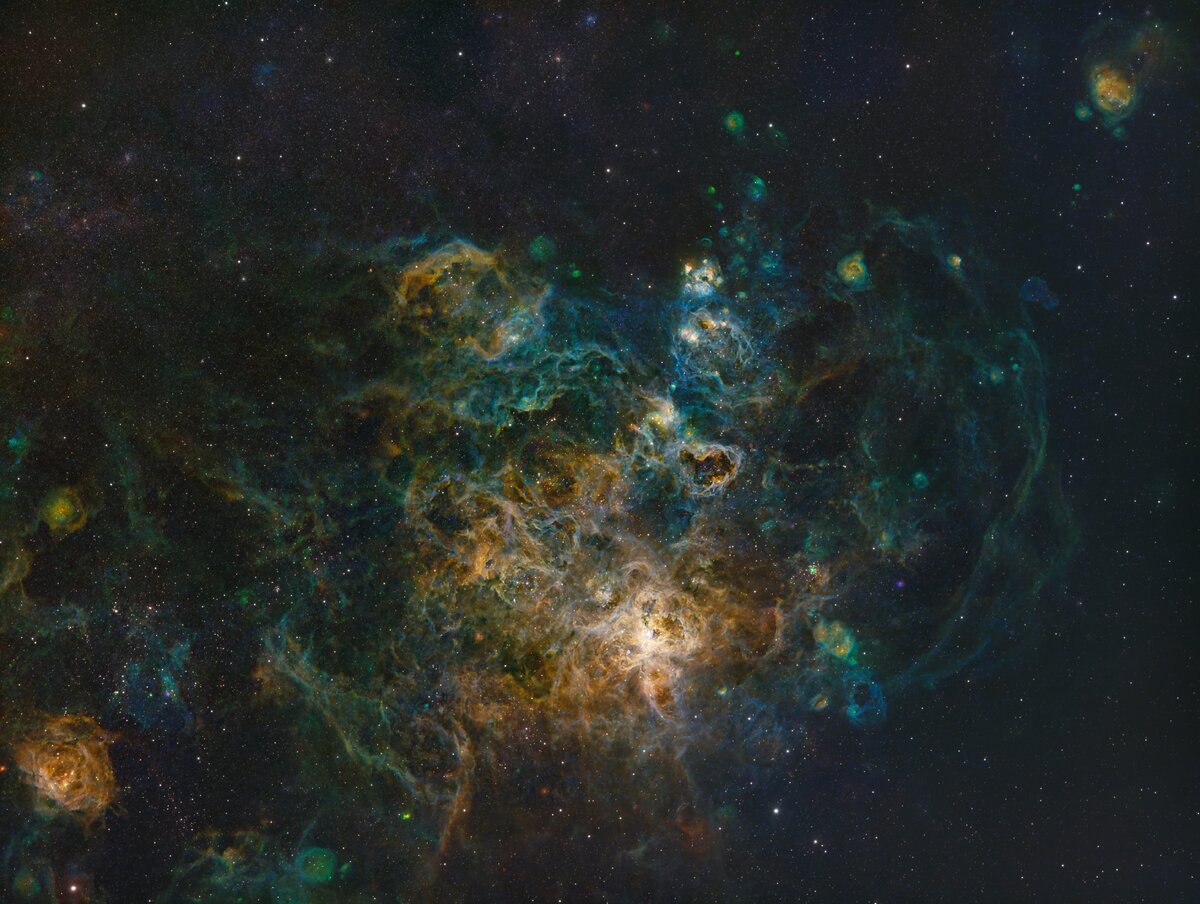
With the advent of AI I thought I'd task Claude with teaching me how to use NINA, which it did, very patiently, and last night when I put the scope under the dark for the first time using NINA to control it, I turned to Claude when I hit bumps in the road. In the end, I wound up with a successful night of imaging, which resulted in this image of one of my favourite targets, the Tarantula Nebula NGC2070. It looks like it'll be clear again tonight and tomorrow, so I'll see if I can repeat my results again, perhaps with less AI hand-holding!
A similar thing has happened to me. I bought myself a rotator to go with my refractor, thinking that would be that. But no--the rotator required an additional USB port that my ASIAIR didn't have, and attempts to use a splitter were not very successful. That led me to buy a powered hub that not only would give me more USB ports, but also could control power output to my devices. But that wasn't compatible with the ASIAIR so I faced the decision that I had long been putting off--learning how to use NINA to control my imaging sessions.
NINA is free, and it's powerful, but it is NOT user-friendly, at least not to start out. It has so many modules and panels that it just looks like the cockpit of a 747 compared with the ASIAIR's much more limited interface. But whereas the ASIAIR ties you into the ZWO ecosystem, NINA lets you use whatever you like, which is a big plus (and when we eventually make it into our new house, I'll have a dome on my observatory that only NINA can control, which is why I knew I'd have to learn to use it eventually).
With the advent of AI I thought I'd task Claude with teaching me how to use NINA, which it did, very patiently, and last night when I put the scope under the dark for the first time using NINA to control it, I turned to Claude when I hit bumps in the road. In the end, I wound up with a successful night of imaging, which resulted in this image of one of my favourite targets, the Tarantula Nebula NGC2070. It looks like it'll be clear again tonight and tomorrow, so I'll see if I can repeat my results again, perhaps with less AI hand-holding!

 I have used NINA a little bit a few years ago, and while it's powerful, I agree it has a super huge learning curve.