

Douglas Sherman
Staff
A few different meteorologic conditions for today.
Pyrocumulus cloud: These are formed in association with forest fires. The rising smoke is full of condensation nuclei. As the smoke rises and cools it reaches the dew point and a cumulus cloud forms. This one is at Glacier National Park.

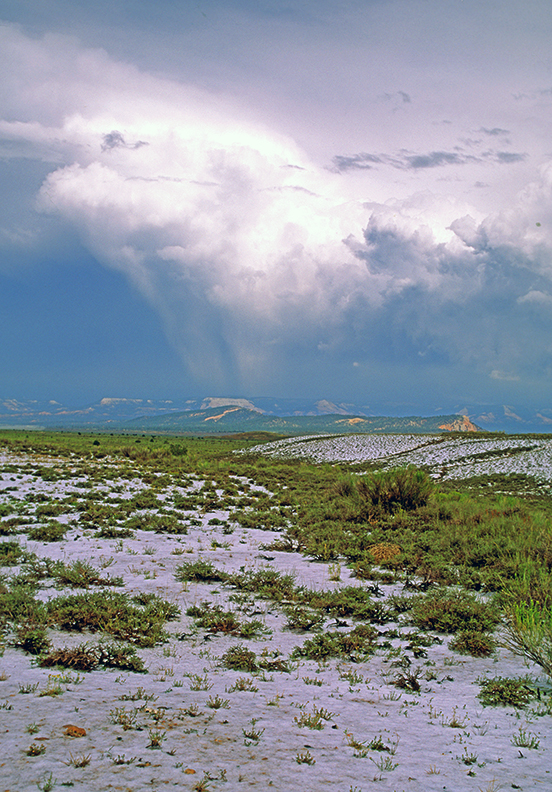
Hail Streak: As a thunderstorm producing hail moves along, it leaves a path covered by hail called a hail streak. This one is near Bryce Canyon National Park.
Hail structure: Hail is produced when updrafts in a thunderstorm carry raindrops aloft to altitudes where they freeze. they get heavy enough to fall but get caught in another updraft and add a layer of new ice. As you can see in the image below this creates a concentric structure in the hail stone. The hail stones below are the size of nickels. Large hailstones usually consist of numerous hailstones fused together and thus have a lumpy look.

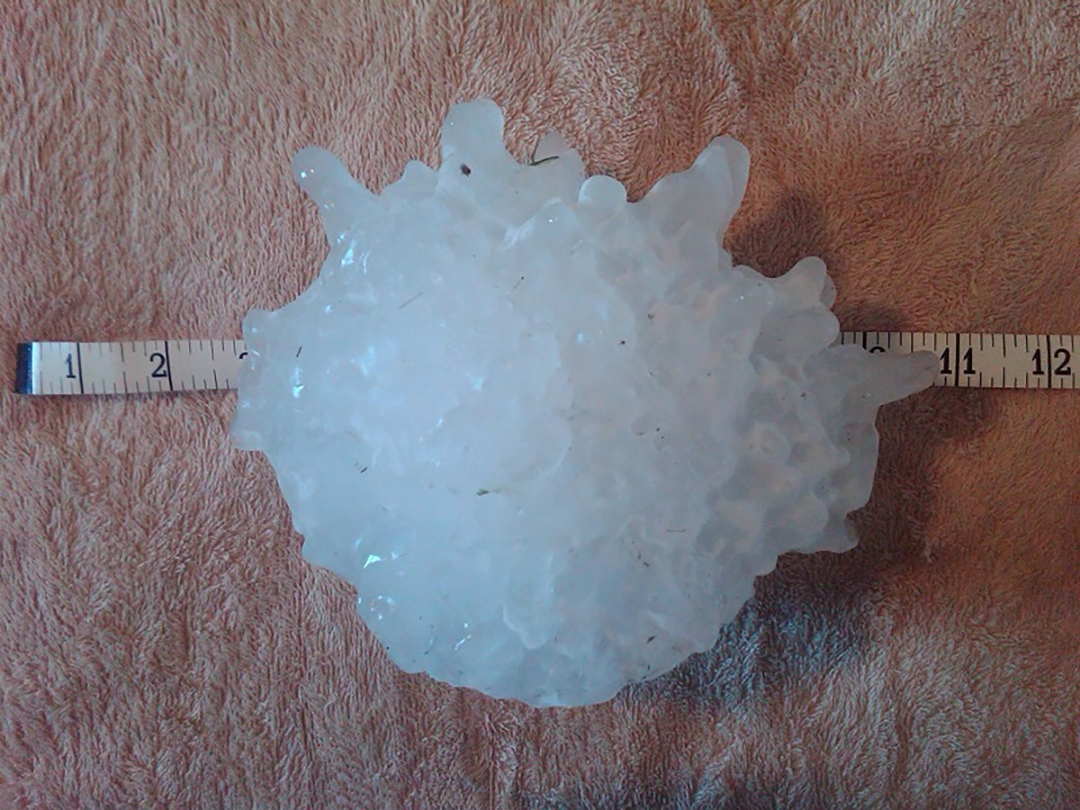
The largest hailstone ever to fall in the U S was in Vivian, South Dakota. on July 23, 2010. It measured eight inches in diameter and weighed 1.94 pounds. The picture of it below is not mine. This storm also produced 80 mph and a tornado.
Finally, another form of precipitation is graupel. It does not form in thunderstorms but when supercooled water droplets come in contact with snowflakes. The resulting crystal is commonly cone shaped, kind of slushy and when they hit the ground they tend to bounce. They also tend to melt right away if the temperature is above freezing at ground level.
This image was taken in Yellowstone National Park.

Pyrocumulus cloud: These are formed in association with forest fires. The rising smoke is full of condensation nuclei. As the smoke rises and cools it reaches the dew point and a cumulus cloud forms. This one is at Glacier National Park.
Hail Streak: As a thunderstorm producing hail moves along, it leaves a path covered by hail called a hail streak. This one is near Bryce Canyon National Park.
Hail structure: Hail is produced when updrafts in a thunderstorm carry raindrops aloft to altitudes where they freeze. they get heavy enough to fall but get caught in another updraft and add a layer of new ice. As you can see in the image below this creates a concentric structure in the hail stone. The hail stones below are the size of nickels. Large hailstones usually consist of numerous hailstones fused together and thus have a lumpy look.
The largest hailstone ever to fall in the U S was in Vivian, South Dakota. on July 23, 2010. It measured eight inches in diameter and weighed 1.94 pounds. The picture of it below is not mine. This storm also produced 80 mph and a tornado.
Finally, another form of precipitation is graupel. It does not form in thunderstorms but when supercooled water droplets come in contact with snowflakes. The resulting crystal is commonly cone shaped, kind of slushy and when they hit the ground they tend to bounce. They also tend to melt right away if the temperature is above freezing at ground level.
This image was taken in Yellowstone National Park.
Last edited:


