M51 Widefield

Mike Lewis

Staff Member
So this is hopefully a tantalizer of what will prove to be a number of images I am going to be able to finally post. This is the last thing I collected while my friend was down in AZ the first time, putting the last 48 minutes into this to cap off about 37 hours of data collection. It will take me significantly longer to post process all of that than it took to collect :) But I love that part of it too, so actually a great activity when one is trapped indoors. And since my friend just arrived back in AZ for this latest new moon cycle, I hope to be back collecting even more data very soon.

This is a small (48 minute total integration) stack of M51, The Whirlpool Galaxy, an iconic astro target that needs little introduction. Andrew has already treated you to a closer view of this amazing object. Since my gear is remote and I cannot swap telescopes, I am constrained to my 580mm view. But even smaller and with only a small amount of data, this relatively bright galaxy pair makes for a very fun widefield shot. I also did not realize all the small faint galaxies that are also visible in the image, especially the larger gallery view.
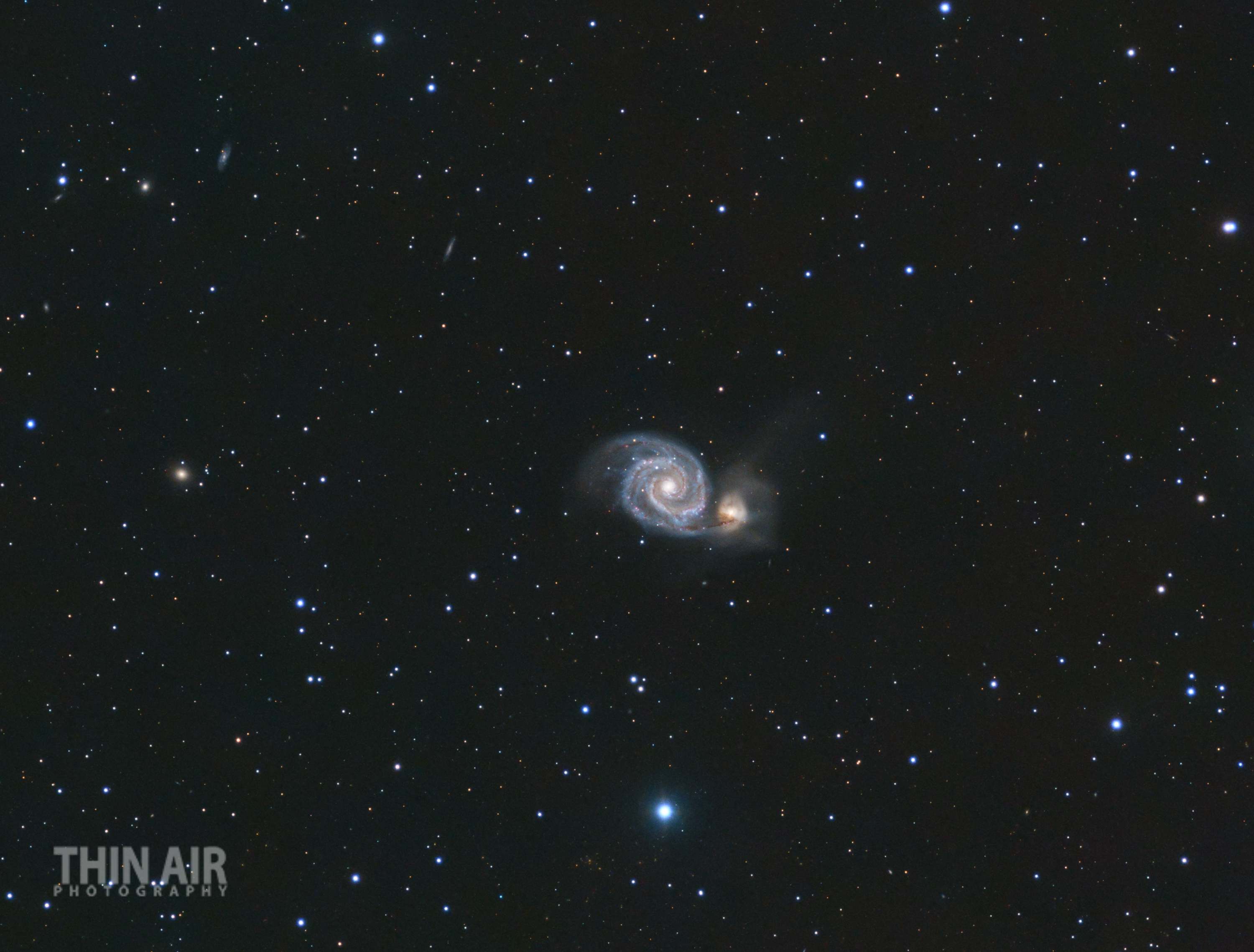

Equipment:
ZWO ASI1600MM-C Camera @ -20C and
Gain:139 Offset:21
Software Bisque MyT Mount
Stellarvue SVQ100 Astrograph Refractor, 580mm @ f/5.8

Software:
Pixinsight Commercial Version 1.8
Lightroom CC
Photoshop CC

Light Frames:
Luminance
: 12 x 60 secs (12 mins)
Red: 12 x 60 secs (12 mins)
Green: 12 x 60 secs (12 mins)
Blue: 12 x 60 secs (12 mins)

Dark Frames:
20 x 60 secs (20 mins)

Flat Frames
20 each filter, durations as required

Bias Frames
30 x 0.001 secs (shortest supported exposure length)

Comments welcome, and thanks for stopping by the FW astro forum!

ML
 
Last edited:

JimFox

Moderator
Staff member
What a tantalizing treat Mike! M51 is one I have my eye on, but considered it too small for me to be able to find. Is this cropped at all? Is the 580mm a telescope focal length or camera lens focal length? I ask because if I shot with my 150-600mm Tamron is this about what I would see at 600mm?

Any, it's fun to start picking out some of the galaxies. I don't know their names but I can atleast spot them and pick them out from the stars. :)

So you didn't use any Flats or Bias frames? Just Darks? The quality looks great.

This is top notch! And thanks for sharing it in the FW Astro Forum. With photos like yours, Andrews and Tony's hopefully we can bring in more Astro photographers.
 

Mike Lewis

Staff Member
What a tantalizing treat Mike! M51 is one I have my eye on, but considered it too small for me to be able to find. Is this cropped at all? Is the 580mm a telescope focal length or camera lens focal length? I ask because if I shot with my 150-600mm Tamron is this about what I would see at 600mm?

Any, it's fun to start picking out some of the galaxies. I don't know their names but I can atleast spot them and pick them out from the stars. :)

So you didn't use any Flats or Bias frames? Just Darks? The quality looks great.

This is top notch! And thanks for sharing it in the FW Astro Forum. With photos like yours, Andrews and Tony's hopefully we can bring in more Astro photographers.

Jim,

Actually this did use Flats (20 for each filter) and Bias (30 frames I think...) I got in the habit of not posting that info in more general photo sites because it just confuses a lot of folks. But we now have a sophisticated astroimaging clientele here at FW, so I will have to start adding that info in! :)

AS for the focal length, my 580mm should match up to your 600mm detail-wise, although pixel size and Bayer filter might get into that a little bit. My astro camera has 3.8 micron pixels, likely a little smaller than your DSLR? And having no Bayer filter means each color uses every pixel on the sensor. That is likely a very small contributor to detail gathering, but probably a factor if dealing with very good seeing.

The bigger consideration though is the sensor size. My astro camera is using a 4/3rds sized sensor (which up until reasonably recently was a LARGE sensor by astro camera standards.) Meaning the usual crop factor discussion comes into play here. So while the actual focal lengths are equivalent, the apparent focal length for me will be higher. Of course you can just crop more to get the same effect.

Lastly though, this image was drizzled up to a 2x size (actually 2x in each dimension for a 4x area increase) and then cropped a little bit. That gets a little confusing, but I think that means my effective pixels are now 1/2 the size. I find that smooths things out nicely, as well as giving me more cropping power, without visually affecting to any great degree the apparent sharpness. The Drizzle algorithm I think came from some processing scheme for satellite data of some kind and then eventually found its way into certain dedicated astro processing packages. It doesn't work well with higher magnification images but for wider field stuff it can be nice. Like lots of other astro techniques though, it needs to be judiciously applied - not every image under every sky can benefit from it. For my astro processing software (PixInsight) the options for it are easy to enable and use, with the final output being a step after you have produced the native resolution image. So I almost always create both versions, and then zoom in to see what the comparisons are like. Anyway, you should read up on the technique because I am very much a "I use it without really understanding the origin of it or the sophisticated math behind it" type of user.

The big jump on this image for me was finding a good tutorial for noise reduction using 2 PixInsight NR tools, TGVDeNoise and MMT (Multiscale Median Transform) that combined to really get after both the high frequency and lower frequency noise while being able to safely protect the stars and the galaxy detail. I will be using those tools going forward, and probably should even consider going back to reprocess some earlier stacks using those tools and techniques. That however is a hard sell when I have all this new data to process and more new data coming in too!

ML
 

JimFox

Moderator
Staff member
Thanks Mike, I have been seeing Drizzle in other Astro comments and other then thinking of frosting being drizzled onto a doughnut, I wasn't sure what that meant. :rolleyes:

That's right, your sensor is a 4/3rds, so that's smaller then a cropped sensor. It's all helpful mentally to be able at a glance get a general idea when I translate what you are capturing into my head for what I am using. I also know tons of photographers are drawn to Crop sensor cameras simply because it gives them more effective "reach". One tool that the other camera makers have finally caught up to Nikon is to be able to change a Full Frame sensor like the D850 into a Crop sensor. I haven't used that so far in the 2 times I have gone out to shoot, but this next time I plan on trying to make use of that. It would turn my max 600mm into 840mm.

Is Drizzle something that's done inside Pixinsight? Or a separate app?

And please, add all detail here as I am really hoping we can grow our Astro group here. Also, be sure to take advantage of our Gallery to post your photos in there too. In the description you can add all of your technical info. Our Gallery is a very general basic gallery in terms of gallerys, kind of like the defunct Pbase Galleries. But after our forum upgrade, I plan on looking into ways to help make our Gallery more useful. Message me or text me if you have specific idea's on how we could change it.
 

Dean

Well-Known Member
Mike,
Outer Worldly :)
Great stuff, I also enjoyed reading your explanation to Jim.. Astro images are really amazing in every aspect .. the end results, what you put in to get them is also incredible I applaud your effort and enthusiasm. Keep em coming.
Regards,
Dean
 

Mike Lewis

Staff Member
Wow - thanks everyone! Did not expect Daily featured status! Cool!

Jim,

Thanks to early input from Alan, I post literally everything in the gallery and then link that into whatever forum I am posting in. I like being able to have a larger view available to viewers, and having a way to keep track of what I have posted is a very welcome benefit too. I will go check out the gallery changes now - sounds cool!

ML
 

Terry Farrow

Well-Known Member
So this is hopefully a tantalizer of what will prove to be a number of images I am going to be able to finally post. This is the last thing I collected while my friend was down in AZ the first time, putting the last 48 minutes into this to cap off about 37 hours of data collection. It will take me significantly longer to post process all of that than it took to collect :) But I love that part of it too, so actually a great activity when one is trapped indoors. And since my friend just arrived back in AZ for this latest new moon cycle, I hope to be back collecting even more data very soon.

This is a small (48 minute total integration) stack of M51, The Whirlpool Galaxy, an iconic astro target that needs little introduction. Andrew has already treated you to a closer view of this amazing object. Since my gear is remote and I cannot swap telescopes, I am constrained to my 580mm view. But even smaller and with only a small amount of data, this relatively bright galaxy pair makes for a very fun widefield shot. I also did not realize all the small faint galaxies that are also visible in the image, especially the larger gallery view.


Equipment:
ZWO ASI1600MM-C Camera @ -20C and
Gain:139 Offset:21
Software Bisque MyT Mount
Stellarvue SVQ100 Astrograph Refractor, 580mm @ f/5.8

Software:
Pixinsight Commercial Version 1.8
Lightroom CC
Photoshop CC

Light Frames:
Luminance
: 12 x 60 secs (12 mins)
Red: 12 x 60 secs (12 mins)
Green: 12 x 60 secs (12 mins)
Blue: 12 x 60 secs (12 mins)

Dark Frames:
20 x 60 secs (20 mins)

Flat Frames
20 each filter, durations as required

Bias Frames
30 x 0.001 secs (shortest supported exposure length)

Comments welcome, and thanks for stopping by the FW astro forum!

ML
You have an incredible amount of patience and skill Mike. Thanks for sharing this stunning image.
 
Top Bottom