Last Image of 2024

JimFox

Moderator
Staff member
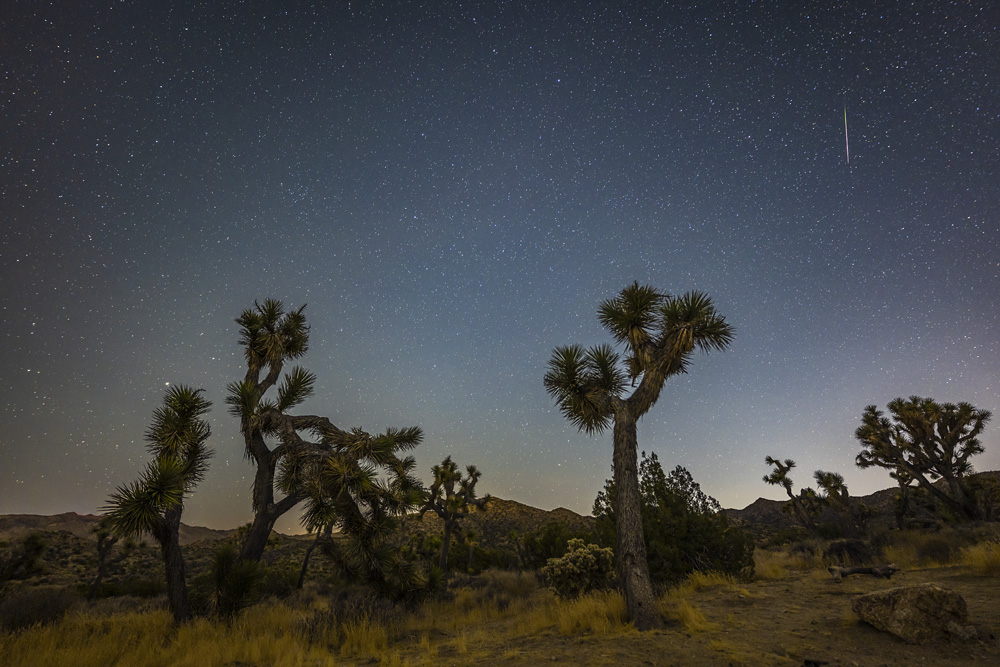
This is going to be my last image processed for 2024. I am getting it in, just under the wire at 11:32pm Pacific Time.

I captured this 3 weeks ago, I was out in Joshua Tree National Park to set up my telescope and image some Deep Space Objects, but as is most often the case, I set up a camera or two to capture the night sky in a timelapse. For half of the year that revolves around the Milky Way, but in the winter time, the Milky Way becomes more shy. While it's still in the sky, it becomes much fainter, and then add to that a pretty strong moon on this night, the Milky Way didn't stand a chance.

Fortunately I just love the night sky, all of it. :) Long before the Milky Way became the craze, I would still be up at night just photographing the star filled skies at night. So images like this, which is later in the night, the Winter Milky Way that had been in the scene had passed, the moon had set so the landscape was all in shadow. As I was scrolling through the images one by one, I noticed that I captured about 6 meteors during the night. This was the most colorful of the bunch, so I decided to process this one. It's all one image.

Nikon Z8
Sigma 14mm f1.4 with Sony to Nikon Z adapter

ISO 800
f1.6
20 secs

All comments are welcome,

Jim
_NZ83312_dw.jpg
 

Beth

Well-Known Member
nicely processed. the foreground tones blend well with the sky in this one.
 

Michael13

Well-Known Member
I agree with you that the whole night sky is worthy of serious consideration for photography, not just the area containing the core of the Milky Way! Moonlight and moon shadows are also under rated. More. please!
 

JimFox

Moderator
Staff member
I agree with you that the whole night sky is worthy of serious consideration for photography, not just the area containing the core of the Milky Way! Moonlight and moon shadows are also under rated. More. please!
Thanks Michael!

I should do one of the images with the shadows from the Joshua Trees across the ground layer.
 

JimFox

Moderator
Staff member
Nice work Jim. Just curious - what percentage of your images do you actually end up processing?
I appreciate that Jameel.

I out kick my coverage as the football terms go. At the end of the year, I will literally have dozens of folders of images from places I have gone and photographed that I didn't even process a single photo, and this last year was no exception.

It's funny, I have thought that if something happened to where I couldn't take a single new photo, I literally have a couple hundred thousand photos I could process and produce a new photo every day for the next 20 years. For example I went to Alaska about 15 years ago and I ended up only processing 1 photo out of that 2 week trip. It took me 10 years to get back to it and process 2 more images. The reason I didn't was because as soon as I came back from that trip I went straight to a 3 day trip to Havasu Falls. So those were the photos I worked on when I got a break.... o_O

What made you think about that?

PS. I decided to plug in my 2024 backup/backup drive it's 14tb and full. It would only hold images from January to September before it got full, so I have a smaller one for the rest of the year. But in the first 9 months of the year from 2024 here are the stats.

1761 Folders
331,560 images

it's a good thing that I enjoy the journey as much as the result. :)
 

Kyle Jones

Moderator
I'm with you on just enjoying shooting at night. I still like simple moonlit landscapes and starfield skies. This image suits that nicely with the meteor adding a nice touch. I like the exposure on the ground layer as well - dark as you'd expect at night but enough detail to hold interest.
 

JimFox

Moderator
Staff member
I'm with you on just enjoying shooting at night. I still like simple moonlit landscapes and starfield skies. This image suits that nicely with the meteor adding a nice touch. I like the exposure on the ground layer as well - dark as you'd expect at night but enough detail to hold interest.
Thanks Kyle. That's really the trick to get the ground to show detail, but not so much that it no longer looks like it was taken at night.
 

Jameel Hyder

Moderator
Staff member
I appreciate that Jameel.

I out kick my coverage as the football terms go. At the end of the year, I will literally have dozens of folders of images from places I have gone and photographed that I didn't even process a single photo, and this last year was no exception.

It's funny, I have thought that if something happened to where I couldn't take a single new photo, I literally have a couple hundred thousand photos I could process and produce a new photo every day for the next 20 years. For example I went to Alaska about 15 years ago and I ended up only processing 1 photo out of that 2 week trip. It took me 10 years to get back to it and process 2 more images. The reason I didn't was because as soon as I came back from that trip I went straight to a 3 day trip to Havasu Falls. So those were the photos I worked on when I got a break.... o_O

What made you think about that?

PS. I decided to plug in my 2024 backup/backup drive it's 14tb and full. It would only hold images from January to September before it got full, so I have a smaller one for the rest of the year. But in the first 9 months of the year from 2024 here are the stats.

1761 Folders
331,560 images

it's a good thing that I enjoy the journey as much as the result. :)
Some mind boggling numbers. The reason I asked is the time it takes to process images (atleast in my case) is quite a bit compared to what it takes to capture.
 

JimFox

Moderator
Staff member
Beautiful and peaceful image Jim. How are you assessing focus when it is dark?
Thanks so much Alan! I like how you described it.

This is the trickiest lens I have because its designed for Mirrorless so it doesn't have a distance scale on it.

My older lenses with a distance scale I have each one memorized where I need to set the focus at on the scale to achieve Hyperfocal Distance. Since I am out shooting the night sky 40 or 50 nights a year, I know exactly where to turn each lens. I don't even double check on most of them.

Now mirrorless is making it harder since the Autofocus lenses are focus by wire and there is no distance scale. But one lens company got very smart! Viltrox. They make a 16mm f1.8 lens with a small LCD display on it, and I have it set to distance. So when I turn the camera on, I just turn the dial to around 19.9 to 26.2 feet, and my focus is always perfect. I wish more lenses came with that.

I did see in the latest firmware upgrades to the Nikon Z6III and the Z8, that Nikon finally has added a readout of the actual distance instead of just a bar that moves. So for this lens, the Sigma 14mm f1.4, I could set up the focus, see what the distance is, and then use that number from now on.

I have probably said too much and maybe didn't even answer your question.

What I am looking for when I focus, is when the first stars appear, I will zoom in on a star and then rock the focus back and forth until the star is it's smallest. That means it's in focus. When a star isn't in focus it is larger, so just rock it back and forth and settle on the smallest the star is. I then take a photo and double check that my foreground is sharp. I try to make sure my foreground, like the trees are always about 10 to 12 feet away.

I prefer to have the actual scale, as then I can preset my focus and start my timelapses before sunset. I like to have my night time timelapses go from daylight to night and back to daylight. A bit more ambitious then a lot of people, but I like seeing the transitions in my timelapses.

I hope that answers your question.
 
Top Bottom