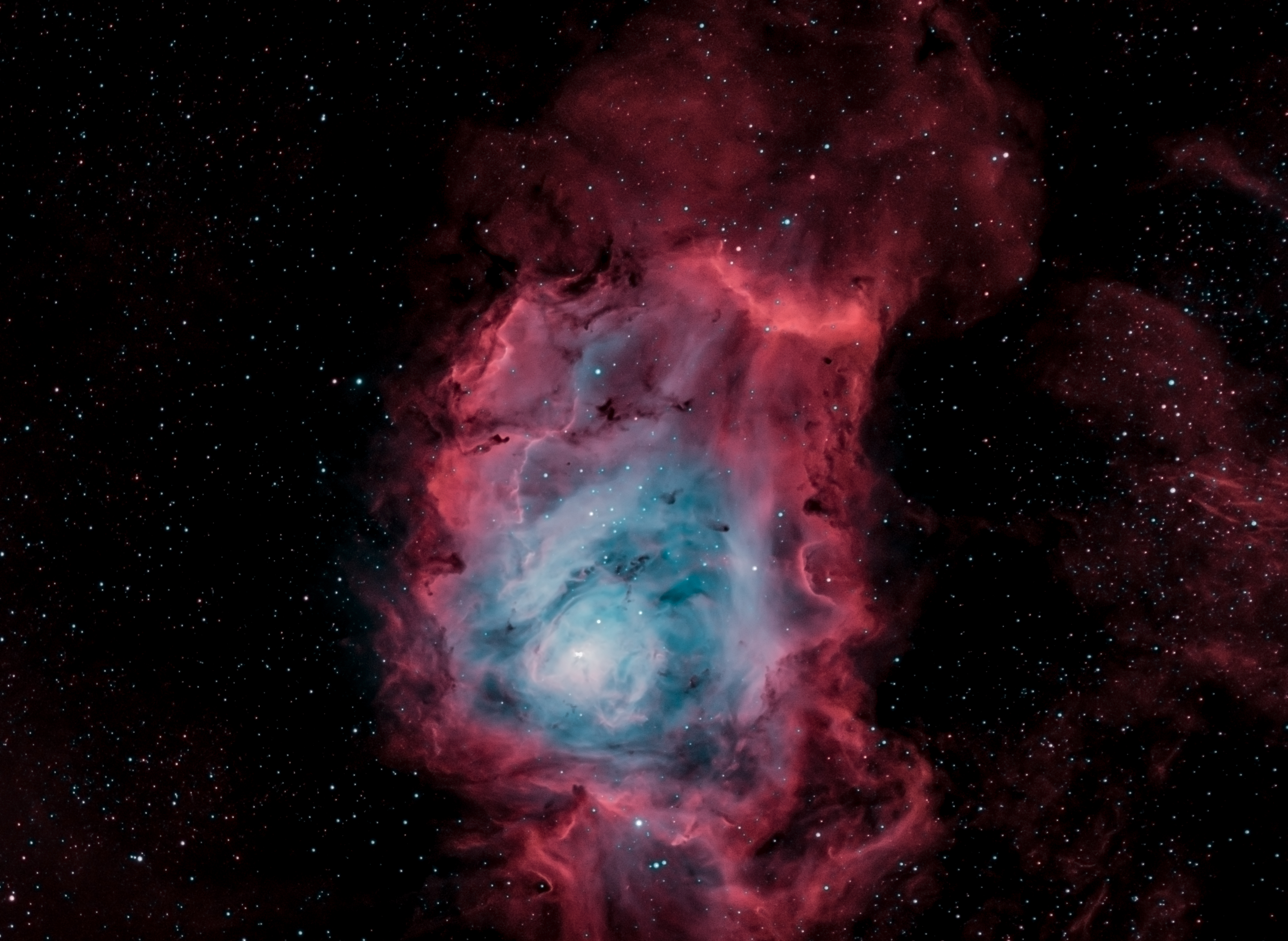
Lagoon Nebula (M8) in Narrowband Bi-color

Mike Lewis

Staff Member
The Lagoon Nebula (catalogued as Messier 8 or M8, NGC 6523, Sharpless 25, RCW 146, and Gum 72) is a giant interstellar cloud in the constellation Sagittarius, and is located at an estimated distance of between 4,000 to 6,000 light years from Earth. It is one of only two star-forming nebulae faintly visible to the eye from mid-northern latitudes under dark skies.

This is a narrowband bicolor image, produced by shooting through 2 separate filters that pass very specific wavelengths of light, Hydrogen-alpha (H II) and Oxygen III. In this image, the H-a emissions are mapped to the red channel, and the OIII emissions are mapped to the green and blue channels.

Equipment:
ZWO ASI1600MM-C Camera @ -15C and
Gain:139 Offset:21
Software Bisque MyT Mount
Stellarvue SVQ100 Astrograph Refractor, 580mm @ f/5.8

Software:
Pixinsight Commercial Version 1.8
Lightroom CC
Photoshop CC

Light Frames:
Ha
: 9 x 240 secs (36 mins)
OIII: 7 x 240 secs (28 mins)

Dark Frames:
10 x 240 secs (40 mins)

Comments and critiques welcome!

ML
 

JimFox

Moderator
Staff member
Hey Mike, this is really cool indeed. How interesting to see the detail in that interstellar cloud.

So you are listing this as taken at 580mm, is that a real camera focal length of 580mm? And did you crop at all?
 

Mike Lewis

Staff Member
Hey Mike, this is really cool indeed. How interesting to see the detail in that interstellar cloud.

So you are listing this as taken at 580mm, is that a real camera focal length of 580mm? And did you crop at all?
Jim,

Thanks for the kind comments. So in this case the ‘lens’ is a telescope, which sports specs of f/5.8 @ 580mm, as it is a 100mm aperture scope. Scopes are always specified by aperture and f number with the focal length falling out from those 2. Of course scopes are designed to run ‘wide open’ and optimized for focus at infinity basically, so the optical designs are much simpler than your typical lens might be (this scope has 4 total elements in it for example). One of the reasons they generally out perform even expensive lenses as far as rendering round stars to the edge if the FOV.

This image is also shot with a dedicated Astro camera instead of a DSLR. The camera actually uses a digital camera sensor designed by Panasonic and I think originally used in an Olympus camera if I recall correctly. It is a 4/3 sized sensor which is small in today’s digital camera market but amazingly still considered somewhat large in the land of Astro cameras. And this camera was one of the first CMOS monochrome cameras to hit a market that had been dominated by older and much more expensive CCD based camera designs. There are larger CMOS sensors out there but they are all one shot color Bayer array sensors which do not do as well with narrowband imaging in particular, and then lots of older design CCD cameras that are all much more expensive. Considering the level of complexity compared to even a low end DLSR it is hard to believe how much more money the Astro cameras are, but just goes to show the money saved when the number of units sold is so much higher for mainstream photography. And as you can imagine, finding a supply of commercially available CMOS monochrome sensors to be used in dedicated Astro cameras has been an issue, as everyone uses sensors originally put in digital cameras. But I digress.

As for cropping, I am not at my computer but I can virtually guarantee this has been cropped some, as almost all Astro images have some crop applied, as once again, even with higher end scope optics the stars at the edges of the FOV can have some issues. In the case of this image you can see that the object is a bit cramped, and probably should have had the camera rotated to the other orientation to frame things better. But often once you have things all aligned and working you are not too keen on messing with your setup :) This image was shot with a resolution of about 1.5 arcsec / pixel, which is somewhat under sampled, so a Drizzle algorithm was applied during processing to multiply the resolution by 2x in each dimension. This smooths out the star shapes and makes sure there are no square stars (star so small it illuminated only one pixel) while also allowing some larger prints to be made. I just printed this on metal at 24 x 30 for a present for my daughter and it held up very well at that size.

ML
 

Mike Lewis

Staff Member
Amazing. You set the bar high for folks who want to do astro.
Thanks Ben! The fun thing is that you can get fun images with less involved setups as evidenced by some other posts on this forum. Of course there are ALWAYS more impressive images out there shot with higher end gear, for longer total integration times, under more stable seeing conditions and darker skies. But I find it fun just to compare my results to my previous efforts or to folks using similar gear with similar conditions. And the astroimaging community is very similar to our little FW community in the sense that it is a very supportive group in general. So I hope my stuff will get others interested and wanting to try this stuff out in a more serious way.

ML
 

JimFox

Moderator
Staff member
Jim,

Thanks for the kind comments. So in this case the ‘lens’ is a telescope, which sports specs of f/5.8 @ 580mm, as it is a 100mm aperture scope. Scopes are always specified by aperture and f number with the focal length falling out from those 2. Of course scopes are designed to run ‘wide open’ and optimized for focus at infinity basically, so the optical designs are much simpler than your typical lens might be (this scope has 4 total elements in it for example). One of the reasons they generally out perform even expensive lenses as far as rendering round stars to the edge if the FOV.

This image is also shot with a dedicated Astro camera instead of a DSLR. The camera actually uses a digital camera sensor designed by Panasonic and I think originally used in an Olympus camera if I recall correctly. It is a 4/3 sized sensor which is small in today’s digital camera market but amazingly still considered somewhat large in the land of Astro cameras. And this camera was one of the first CMOS monochrome cameras to hit a market that had been dominated by older and much more expensive CCD based camera designs. There are larger CMOS sensors out there but they are all one shot color Bayer array sensors which do not do as well with narrowband imaging in particular, and then lots of older design CCD cameras that are all much more expensive. Considering the level of complexity compared to even a low end DLSR it is hard to believe how much more money the Astro cameras are, but just goes to show the money saved when the number of units sold is so much higher for mainstream photography. And as you can imagine, finding a supply of commercially available CMOS monochrome sensors to be used in dedicated Astro cameras has been an issue, as everyone uses sensors originally put in digital cameras. But I digress.

As for cropping, I am not at my computer but I can virtually guarantee this has been cropped some, as almost all Astro images have some crop applied, as once again, even with higher end scope optics the stars at the edges of the FOV can have some issues. In the case of this image you can see that the object is a bit cramped, and probably should have had the camera rotated to the other orientation to frame things better. But often once you have things all aligned and working you are not too keen on messing with your setup :) This image was shot with a resolution of about 1.5 arcsec / pixel, which is somewhat under sampled, so a Drizzle algorithm was applied during processing to multiply the resolution by 2x in each dimension. This smooths out the star shapes and makes sure there are no square stars (star so small it illuminated only one pixel) while also allowing some larger prints to be made. I just printed this on metal at 24 x 30 for a present for my daughter and it held up very well at that size.

ML
Thanks Mike for that info! Now that makes so much sense why although those lenses or telescopes are less expensive, they can out perform high end glass. I appreciate the education!

As I am working towards hopefully getting into some Astro work, my question about cropping was that I didn't know if it was like my current state when I shoot the moon with a 300 mm and then have to crop it like by 90% it feels to get the frame to get filled. So I am not doing any kind of real math here, but shooting something that is 580mm on top of a 4/3rds frame sensor is like shooting with a 1200mm lens on a full frame? Or something in that neighborhood?

I am just trying to wrap my head around what is being photographed and how big or small it is in the sky since the detail you are able to show here is essentially invisible to our naked eye. So as I think about pointing a camera and a lens or perhaps a camera and a telescope into the sky in the future I am hoping to grasp a bit just how big or small a part of the sky when we look up we are talking about capturing. I hope that doesn't sound silly, I am just trying to wrap my mind around this all... :rolleyes:
 

Tom Narwid

Well-Known Member
The Lagoon Nebula (catalogued as Messier 8 or M8, NGC 6523, Sharpless 25, RCW 146, and Gum 72) is a giant interstellar cloud in the constellation Sagittarius, and is located at an estimated distance of between 4,000 to 6,000 light years from Earth. It is one of only two star-forming nebulae faintly visible to the eye from mid-northern latitudes under dark skies.

This is a narrowband bicolor image, produced by shooting through 2 separate filters that pass very specific wavelengths of light, Hydrogen-alpha (H II) and Oxygen III. In this image, the H-a emissions are mapped to the red channel, and the OIII emissions are mapped to the green and blue channels.

Equipment:
ZWO ASI1600MM-C Camera @ -15C and
Gain:139 Offset:21
Software Bisque MyT Mount
Stellarvue SVQ100 Astrograph Refractor, 580mm @ f/5.8

Software:
Pixinsight Commercial Version 1.8
Lightroom CC
Photoshop CC

Light Frames:
Ha
: 9 x 240 secs (36 mins)
OIII: 7 x 240 secs (28 mins)

Dark Frames:
10 x 240 secs (40 mins)


Comments and critiques welcome!

ML[/QUOTE
The Lagoon Nebula (catalogued as Messier 8 or M8, NGC 6523, Sharpless 25, RCW 146, and Gum 72) is a giant interstellar cloud in the constellation Sagittarius, and is located at an estimated distance of between 4,000 to 6,000 light years from Earth. It is one of only two star-forming nebulae faintly visible to the eye from mid-northern latitudes under dark skies.

This is a narrowband bicolor image, produced by shooting through 2 separate filters that pass very specific wavelengths of light, Hydrogen-alpha (H II) and Oxygen III. In this image, the H-a emissions are mapped to the red channel, and the OIII emissions are mapped to the green and blue channels.

Equipment:
ZWO ASI1600MM-C Camera @ -15C and
Gain:139 Offset:21
Software Bisque MyT Mount
Stellarvue SVQ100 Astrograph Refractor, 580mm @ f/5.8

Software:
Pixinsight Commercial Version 1.8
Lightroom CC
Photoshop CC

Light Frames:
Ha
: 9 x 240 secs (36 mins)
OIII: 7 x 240 secs (28 mins)

Dark Frames:
10 x 240 secs (40 mins)


Comments and critiques welcome!

ML
]
Outstanding Mike.
 

Mike Lewis

Staff Member
Thanks Mike for that info! Now that makes so much sense why although those lenses or telescopes are less expensive, they can out perform high end glass. I appreciate the education!

As I am working towards hopefully getting into some Astro work, my question about cropping was that I didn't know if it was like my current state when I shoot the moon with a 300 mm and then have to crop it like by 90% it feels to get the frame to get filled. So I am not doing any kind of real math here, but shooting something that is 580mm on top of a 4/3rds frame sensor is like shooting with a 1200mm lens on a full frame? Or something in that neighborhood?

I am just trying to wrap my head around what is being photographed and how big or small it is in the sky since the detail you are able to show here is essentially invisible to our naked eye. So as I think about pointing a camera and a lens or perhaps a camera and a telescope into the sky in the future I am hoping to grasp a bit just how big or small a part of the sky when we look up we are talking about capturing. I hope that doesn't sound silly, I am just trying to wrap my mind around this all... :rolleyes:

Jim,

No worries. The how big will it appear question is one we always ask, even after fooling around in this hobby for a while. Because once you get away from some very large nebulae or the Milky Way itself, stuff starts to get small in a hurry. My best advice is to check out this Astronomy Tools link I think I posted once before: http://astronomy.tools/calculators/field_of_view/ switch over to imaging mode, and plug some stuff in for camera, telescope (or lens), and object. And then hit Add To View, and you will get a nice bounding box around a representation of the target (or in some cases an actual photographic sky survey image of the target) and be able to see how much of the sensor is filled. The site is set up to expect you to enter telescopes not lenses but by typing in directly to the Focal Length field, and choosing a representative DSLR sensor size( a canon 5D Mk II or II will show what any full frame DSLR FOV is pretty much) you can get a good diagram. The list of digital cameras (as opposed to dedicated astro cameras) is sparse, but once again, use anything with the proper sized sensor to get a representative FOV diagram. So for instead selecting a 4/3 sensor body off the list like the Olypus E-PM1 will show you what a 4/3 sensor will look like with a 600mm lens if you set it up that way. Of course if you do not have an exact match for your camera or scope /lens, you will not get accurate readouts for resolution, but as long as you pick the right camera sensor size and the right focal length, the framing will be representative.

Let me know if you have any other questions!

ML
 
This is a favorite! One of the creamiest images I've seen, and the stars are well-behaved. This is an excellent image of a low-elevation target that's not usually easy to get with such high contrast.

Thanks for sharing!
Bruce
 

Tom Narwid

Well-Known Member
The Lagoon Nebula (catalogued as Messier 8 or M8, NGC 6523, Sharpless 25, RCW 146, and Gum 72) is a giant interstellar cloud in the constellation Sagittarius, and is located at an estimated distance of between 4,000 to 6,000 light years from Earth. It is one of only two star-forming nebulae faintly visible to the eye from mid-northern latitudes under dark skies.

This is a narrowband bicolor image, produced by shooting through 2 separate filters that pass very specific wavelengths of light, Hydrogen-alpha (H II) and Oxygen III. In this image, the H-a emissions are mapped to the red channel, and the OIII emissions are mapped to the green and blue channels.

Equipment:
ZWO ASI1600MM-C Camera @ -15C and
Gain:139 Offset:21
Software Bisque MyT Mount
Stellarvue SVQ100 Astrograph Refractor, 580mm @ f/5.8

Software:
Pixinsight Commercial Version 1.8
Lightroom CC
Photoshop CC

Light Frames:
Ha
: 9 x 240 secs (36 mins)
OIII: 7 x 240 secs (28 mins)

Dark Frames:
10 x 240 secs (40 mins)


Comments and critiques welcome!

ML
Beautiful. I had a 100mm Stellarvue also and a great scope. I did a lot of star clusters. They were fun and lots of them.
 
Top Bottom