Bubble Nebula from Lukomatico Data

JimFox

Moderator
Staff member
Lukomatico is one of my favorite Astrophotographers who has a YouTube channel and has been so helpful. There are 2 or 3 that I enjoy and find easy to learn from, Luke might be at the top of that list.

So recently he captured the Bubble Nebula in both Mono and Color with his Player One Astro cameras and he has shared his stacked data so others can play with it. Which is what I did! :) You download his data and watch his video here:


Here is the technical data:

Celestron RASA11
Uranus-C Pro
Optolong L-Extreme F2 edition
52x2m exposures, 200g 50os
Bortle 7 skies

Photographer : Luke Newbould

Now with this version, I took the Color (OSC) data to play with since I am using a color camera, the ASI2600mc Pro. But I plan to also play with his mono data as I would love to tip my toes into the Mono realm and just see how that works.

I took the data and ended up with a SHO/HOO combination that I liked. I cropped it, though looking at the end image, I am thinking I should go back and crop it a bit tighter.

And as an aside, in his video he talks through how he processed his versions. I have only watched the beginning. I decided I wanted to try processing it without seeing how Luke did it himself, and then go back later and watch it so I can see how his processing was different. I think that would be fun.

All feed back is welcome, and even more I want to invite the rest of you guys to download the data yourself and let's see what you can come up with. I think it would be fun to compare each of our takes on the same data.

Jim
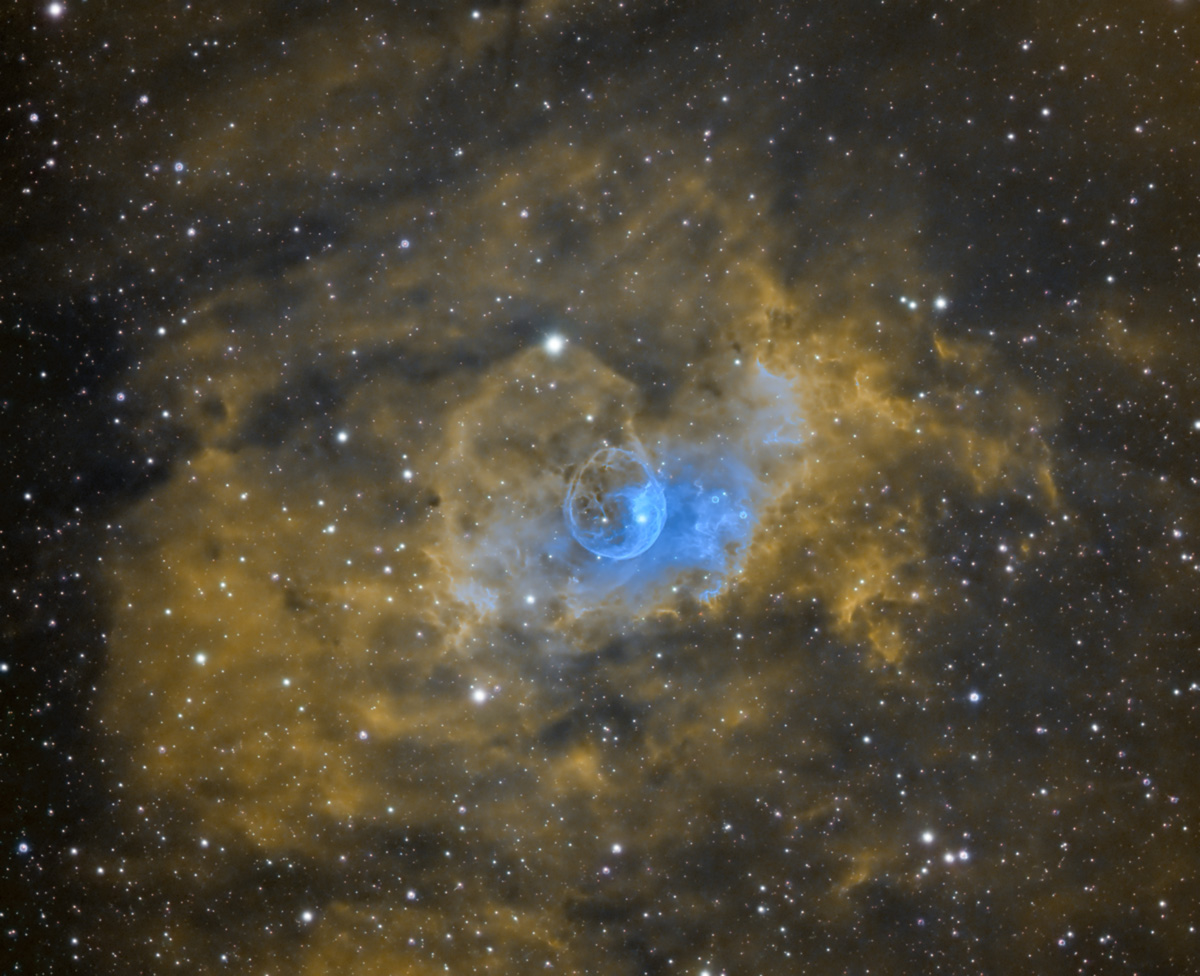
bubble_Crop_ABE_BlurNR_EZStr_NoStars_SHO_HOO_StarsBack_dw.jpg
 

Mike Lewis

Staff Member
So this was a very fun exercise - maybe too fun, as I did spend a bit of time fooling around with the data. I guess that just underscores how much I like the post processing part of this. This was pretty nice data too - really makes me realize how I must get back to this target again and do a proper job on it, as my only image so far was from before I had fixed some tracking issues and moved may gear to AZ. In any case, here is my effort.

LRCC_sRGB_FW_LukeBubble_SHO_BBNBN_SHO-1-2-0-1-1_05-1-1-1_1-1_SCNR-MaxM-0_2_NXT-75-15_PSCC_YelM...jpg


I like to leave some green in the SHO palette (after all in the SHO palette Hα, typically the strongest channel, IS mapped to green), but I do tone it down and shift it a bit. In this case I used an SHO channel combination, then Bill Blanshan's NB normalization, then lots of typical yanking around in Photoshop, then the cool colormasking tweaks Luke showed in the excellent video, and finally some minor mods in Lightroom. I did process the nebula without the stars and then added them back in and star reduced the final result. if this had been my target I would have collected separate RGB stars. In any case, I did like the varied colors I was able to extract from the data. A fun exercise for me during what can best be described as my post-processing season (but which is referred to as monsoon season down in AZ where my gear is located :) )

ML
 

JimFox

Moderator
Staff member
So this was a very fun exercise - maybe too fun, as I did spend a bit of time fooling around with the data. I guess that just underscores how much I like the post processing part of this. This was pretty nice data too - really makes me realize how I must get back to this target again and do a proper job on it, as my only image so far was from before I had fixed some tracking issues and moved may gear to AZ. In any case, here is my effort.

View attachment 64245


I like to leave some green in the SHO palette (after all in the SHO palette Hα, typically the strongest channel, IS mapped to green), but I do tone it down and shift it a bit. In this case I used an SHO channel combination, then Bill Blanshan's NB normalization, then lots of typical yanking around in Photoshop, then the cool colormasking tweaks Luke showed in the excellent video, and finally some minor mods in Lightroom. I did process the nebula without the stars and then added them back in and star reduced the final result. if this had been my target I would have collected separate RGB stars. In any case, I did like the varied colors I was able to extract from the data. A fun exercise for me during what can best be described as my post-processing season (but which is referred to as monsoon season down in AZ where my gear is located :) )

ML
Awesome work Mike. I found it a fun exercise too.

Now... I want to challenge you to duplicate this look but using Luke's OSC data. :)
 

Mike Lewis

Staff Member
Awesome work Mike. I found it a fun exercise too.

Now... I want to challenge you to duplicate this look but using Luke's OSC data. :)

Well, that will be a bit tougher, although he did show some techniques. I might have to give it a try.

ML
 

Mike Lewis

Staff Member
Ok, so I went back and had a crack at the OSC data and processing, with the intention of producing something at least similar to the mono data result. This was very cool for me because I am already considering a purchase of a camera with this sensor in it to do planetary imaging, and so seeing what it can do for deep sky imaging was very instructive. Once again, LOTS of cool techniques in the Luke workflow for this that I just never would have thought about. I used the existing stars but if it were me trying this seriously I would have taken separate RGB star data. The cropping and orientation of this image is different from my previous one, and unfortunately that was different from the versions posted by others. In this case I reoriented this one shot color version to match my previous image.

I would say I definitely like what is visible in the mono image more, but then I am also pretty impressed with what the OSC camera was able to do for both color and detail. I do not know much about what telescopes were used between the 2 sets of data, but of course the 2 cameras are quite a bit different. In any case, once again a fun exercise, and this time very instructive for me as well. Here is the 585 OSC sensor based version to compare to the mono camera version posted above (which I believe is from an APS-C IMX571 mono sensor...)

LRCC_sRGB_FW_sRGB_LukeBubble-OSC_SHO_Clean_YMskCT_SCNR_AvgN-50_BMskCT_PSCC_LHE_NXT_HT_WithStar...jpg


ML
 

JimFox

Moderator
Staff member
Ok, so I went back and had a crack at the OSC data and processing, with the intention of producing something at least similar to the mono data result. This was very cool for me because I am already considering a purchase of a camera with this sensor in it to do planetary imaging, and so seeing what it can do for deep sky imaging was very instructive. Once again, LOTS of cool techniques in the Luke workflow for this that I just never would have thought about. I used the existing stars but if it were me trying this seriously I would have taken separate RGB star data. The cropping and orientation of this image is different from my previous one, and unfortunately that was different from the versions posted by others. In this case I reoriented this one shot color version to match my previous image.

I would say I definitely like what is visible in the mono image more, but then I am also pretty impressed with what the OSC camera was able to do for both color and detail. I do not know much about what telescopes were used between the 2 sets of data, but of course the 2 cameras are quite a bit different. In any case, once again a fun exercise, and this time very instructive for me as well. Here is the 585 OSC sensor based version to compare to the mono camera version posted above (which I believe is from an APS-C IMX571 mono sensor...)

View attachment 64286

ML
Hey Mike, great job! I am thinking I like your OSC version better then the mono version. But good job on them both.

The scope used was a RASA 11.
 
Top Bottom