

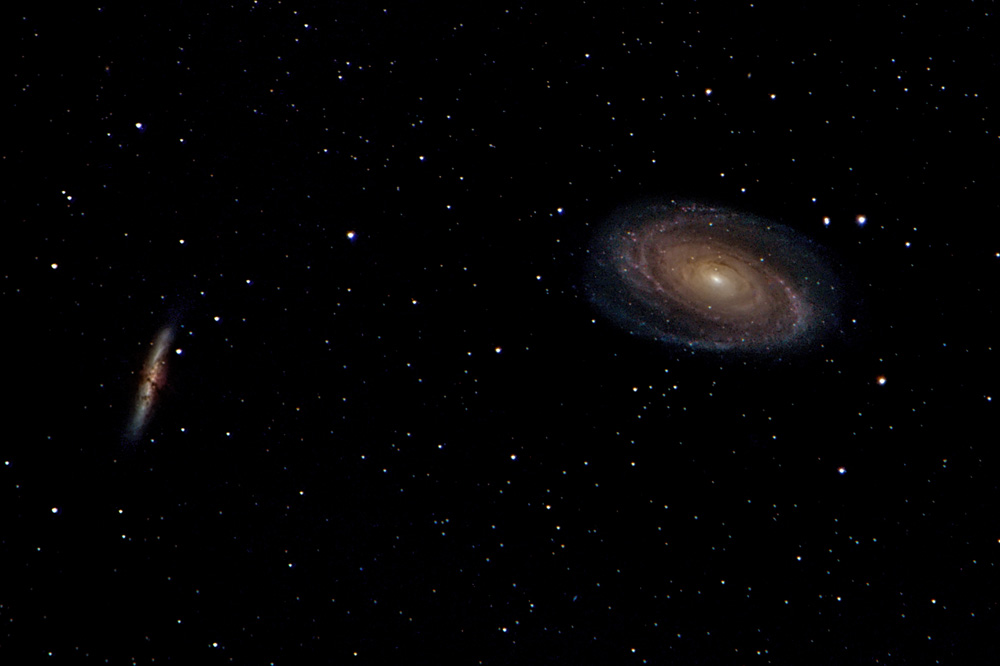
This is of Bodes and Cigar galaxies. I was able to meet up with @Bill Richards again last night and he took me down into the dark sky site for the San Diego Astronomy Association. They have a really nice location.
And if it wasn't for Bill, I wouldn't have been able to capture this last night. It was my first time using my new astro camera, the ASI2600mc Pro. It's a color astro camera. So I had lot's of questions and Bill as always was very helpful. And then I ran into an issue getting the guiding working for the new astro mount, the Gem28 I had gotten for Christmas. Bill spent well over an hour with me at 11pm working through why it wasn't guiding correctly. Thanks to him, we got it figured out, and I was able to start guiding, which is necessary for the longer shutter speeds to keep the stars and the objects in the image nice and sharp.
So this is my first image with the new camera. It's not perfect, I have a lot more to learn, but I think it was good for a first time out with the new camera. The image is probably a bit too dark, even for my standards of liking my astro images darker, but what can I say.... it's how it ended up. I will probably do this one over again later and see if I can pull even more detail out of it.
This is just 2 hours of imaging. While I took darks, flats and bias frames to stack in with this. When I got back home today after being up all night with Bill last night, I got impatient and just stacked the Lights (the images) I captured by themselves just so I could check for sharpness and detail. Once I was pretty happy with that, I had processed it too much and couldn't turn back... So that's why I will need to try it again, but with all of the other frames we take for normal Deep Space Astro stacked into it also.
One of the things that excites me with this image is something I was never able to capture when I was using my Nikon D850 for the Deep Space Astro, and that's if you look at the spiral arms in Bodes, you will see the magenta/red areas and you can also pick out the red star forming regions in the arms. They are a bit faint, but they are there, and I think with more images on it in the future, even more of that detail would come out.
Gem28
ASI2600mc Pro
Tamron 150-600mm @ 600mm f6.3
60 Lights @ 120 secs
Bin1
Gain 50
All comments are welcome,
Jim
And if it wasn't for Bill, I wouldn't have been able to capture this last night. It was my first time using my new astro camera, the ASI2600mc Pro. It's a color astro camera. So I had lot's of questions and Bill as always was very helpful. And then I ran into an issue getting the guiding working for the new astro mount, the Gem28 I had gotten for Christmas. Bill spent well over an hour with me at 11pm working through why it wasn't guiding correctly. Thanks to him, we got it figured out, and I was able to start guiding, which is necessary for the longer shutter speeds to keep the stars and the objects in the image nice and sharp.
So this is my first image with the new camera. It's not perfect, I have a lot more to learn, but I think it was good for a first time out with the new camera. The image is probably a bit too dark, even for my standards of liking my astro images darker, but what can I say.... it's how it ended up.
I will probably do this one over again later and see if I can pull even more detail out of it.This is just 2 hours of imaging. While I took darks, flats and bias frames to stack in with this. When I got back home today after being up all night with Bill last night, I got impatient and just stacked the Lights (the images) I captured by themselves just so I could check for sharpness and detail. Once I was pretty happy with that, I had processed it too much and couldn't turn back...
So that's why I will need to try it again, but with all of the other frames we take for normal Deep Space Astro stacked into it also.One of the things that excites me with this image is something I was never able to capture when I was using my Nikon D850 for the Deep Space Astro, and that's if you look at the spiral arms in Bodes, you will see the magenta/red areas and you can also pick out the red star forming regions in the arms. They are a bit faint, but they are there, and I think with more images on it in the future, even more of that detail would come out.
Gem28
ASI2600mc Pro
Tamron 150-600mm @ 600mm f6.3
60 Lights @ 120 secs
Bin1
Gain 50
All comments are welcome,
Jim


