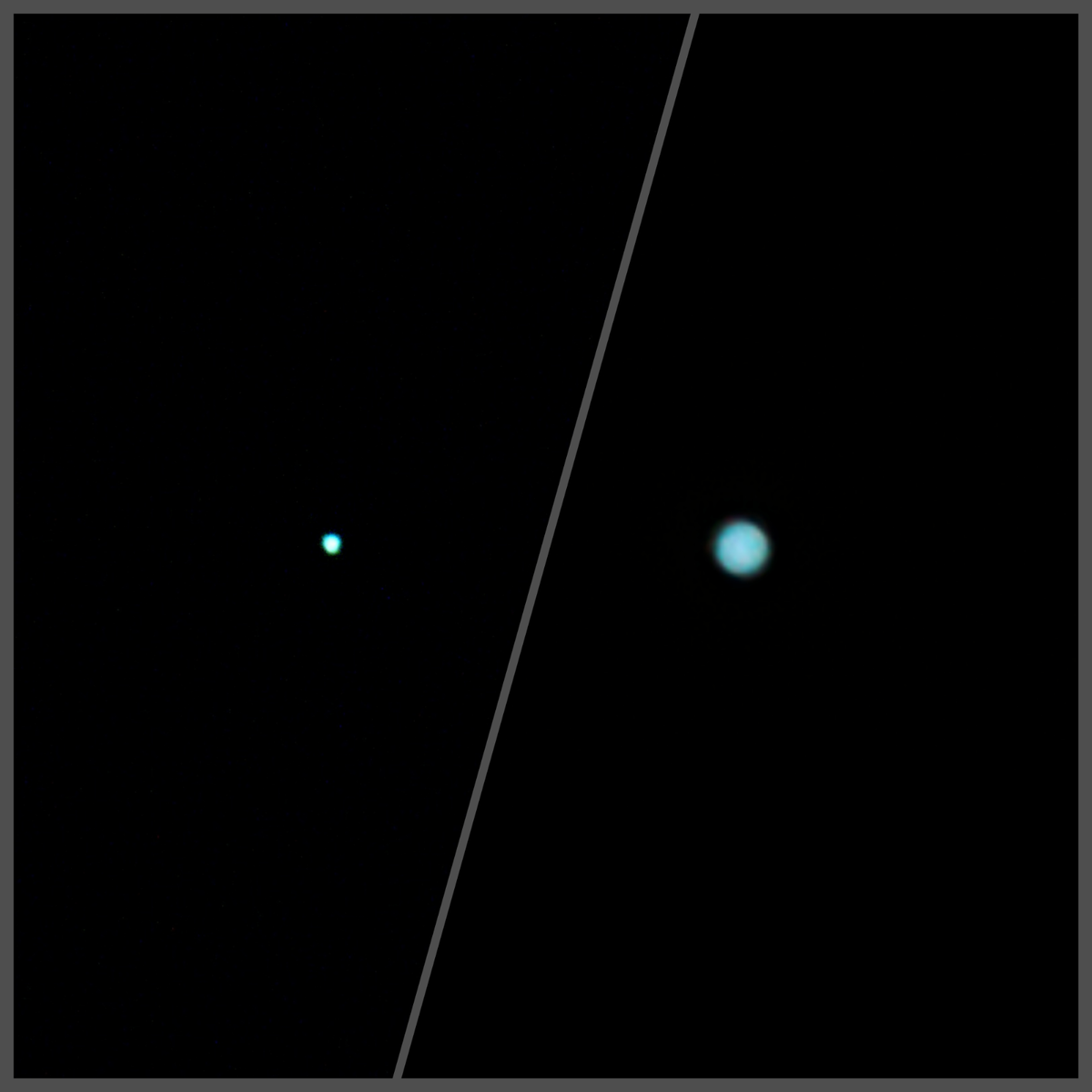
Very cool indeed! I like how you displayed them here.
I was with
@Bill Richards last night at the San Diego Astronomy dark sky site, and it was interesting and impressive to watch Bill set up his Edge 8" HD scope to capture Saturn and Jupiter. It was my first time watching in person someone doing planetary, and wow! That's a lot of work, I would say it's more difficult then regular Astrophotography of Nebula's and Galaxies.
Thank you Jim. That's interesting to me because I see what the DSO guys do and it seems so technical to me. For planetary we (depending on our mount) don't have to polar align, we don't have to worry about guiding, and we don't have to take flats lights darks biases, etc.
On the other hand we are greatly impacted by atmospheric seeing conditions and have to think about technical things such as framerate, gain, etc. Instead of 5 minute still frame exposures we're usually taking between 1 - 3 minutes of video, usually for a total of up to 15 minutes. Then all the post processing begins. There is definitely a learning curve, especially when it comes to using all the software.
Each video is usually cropped and debayered (some folks will still use monochrome cameras & filter wheels for planetary), stacked, sharpened, and then de-rotated, a complicated step in the process (applies to Mars, Jupiter, and Saturn). After that Photoshop will refine the image along with any de-noise software to produce a final result. It's a complicated work flow but I guess I've gotten used to it. When I look at the process for Deep Sky astrophotography, it seems daunting to me by comparison, but maybe I would feel the other way around if I had learned that way instead.
I'd also say that planetary imaging sessions can be shorter just depending, although even on a good night the goal is usually to collect as much data as possible. On occasions where we're going for video showing the rotation of a planet & moons for instance, we're taking those 3 minute clips for 3 to 5 hours at a time.
I would like to learn Deep Sky at some point, but to some degree it does require a separate set of equipment, and of course, the same dedication. Maybe when I retire I can convince my wife we need another telescope & camera. Until then I'll be enjoying all these amazing shots you guys are getting of galaxies & nebulae.

-Josh