

KevinA
Well-Known Member
Another interesting and colourful group of birds is the Bee-eaters. From Wikipedia
"The bee-eaters are a group of non-passerine birds in the family Meropidae, containing three genera and thirty species. Most species are found in Africa and Asia, with a few in southern Europe, Australia, and New Guinea. They are characterised by richly coloured plumage, slender bodies, and usually elongated central tail feathers. All have long down-turned bills and medium to long wings, which may be pointed or round. Male and female plumages are usually similar.
As their name suggests, bee-eaters predominantly eat flying insects, especially bees and wasps, which are caught on the wing from an open perch. The insect's stinger is removed by repeatedly hitting and rubbing the insect on a hard surface. During this process, pressure is applied to the insect's body, thereby discharging most of the venom.
Most bee-eaters are gregarious. They form colonies, nesting in burrows tunnelled into vertical sandy banks, often at the side of a river or in flat ground. As they mostly live in colonies, large numbers of nest holes may be seen together."
White-Throated Bee-Eater, Merops albicollis - Kenya

Northern Carmine Bee-eater, Merops nubicus - Kenya

Little Bee-eater, Merops pusillus - Kenya

European Bee-eater, Merops apiaster - Egypt

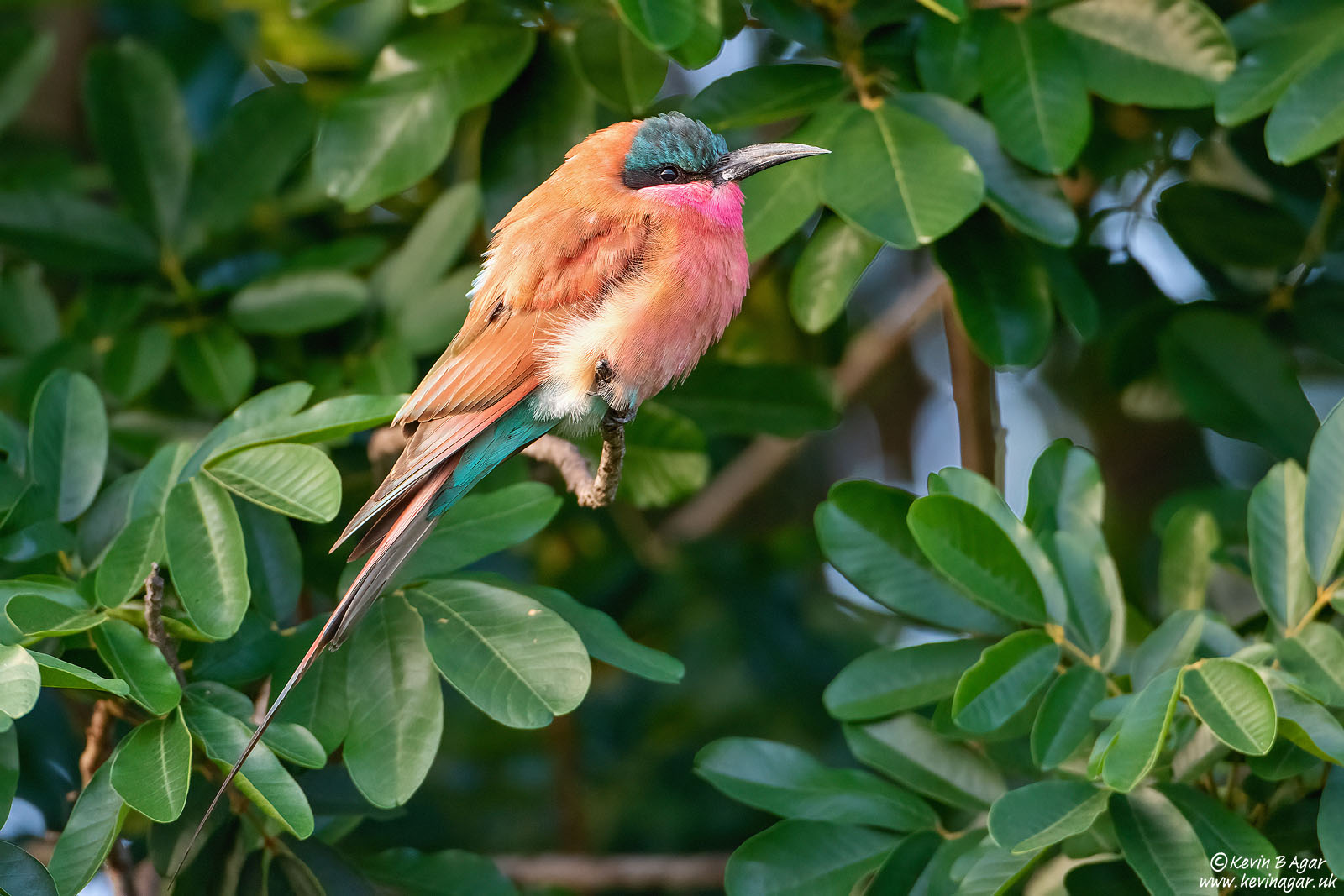
Southern Carmine Bee-eater, Merops nubicoides - South Africa
"The bee-eaters are a group of non-passerine birds in the family Meropidae, containing three genera and thirty species. Most species are found in Africa and Asia, with a few in southern Europe, Australia, and New Guinea. They are characterised by richly coloured plumage, slender bodies, and usually elongated central tail feathers. All have long down-turned bills and medium to long wings, which may be pointed or round. Male and female plumages are usually similar.
As their name suggests, bee-eaters predominantly eat flying insects, especially bees and wasps, which are caught on the wing from an open perch. The insect's stinger is removed by repeatedly hitting and rubbing the insect on a hard surface. During this process, pressure is applied to the insect's body, thereby discharging most of the venom.
Most bee-eaters are gregarious. They form colonies, nesting in burrows tunnelled into vertical sandy banks, often at the side of a river or in flat ground. As they mostly live in colonies, large numbers of nest holes may be seen together."
White-Throated Bee-Eater, Merops albicollis - Kenya
Northern Carmine Bee-eater, Merops nubicus - Kenya
Little Bee-eater, Merops pusillus - Kenya
European Bee-eater, Merops apiaster - Egypt
Southern Carmine Bee-eater, Merops nubicoides - South Africa


