Orion Nebula - 2020/02/19

JimFox

Moderator
Staff member
I am finally having some time to process photos again, so I dug into my Astro backlog and working on the Orion Nebula from February that I had taken. This also includes the Running Man Nebula above Orion.

One of the tips I have picked up is after stacking the multiple images needed to do Astrophotography to then remove the stars from the photo. Removing the stars makes it easier to work on Nebula or object you captured without worrying about the stars going crazy while stretching and pushing the data in the photo. Then when the Nebula or Galaxy is looking like you want it to look like, you make a star mask and put the stars back into the photo.

So this is the 2nd time I have done that. I used a program called Starnet++ to remove the stars. It's a slow stand alone program. It took about 2 hours for it to remove the stars from this. And while it does a really good job, it doesn't do it perfectly, so after it's done you go back over the photo with the healing brush in Photoshop to clear up any odd artifacts.

I am pretty happy with how this turned out and never cease to be amazed at the quality I can get with just a $500 tracker.

Nikon D850
Tamron 150-600mm at 500mm
SkyGuider Pro - Tracker
41 x 30 Sec images at ISO 6400
17 X Dark Frames

All comments are welcome,

Jim
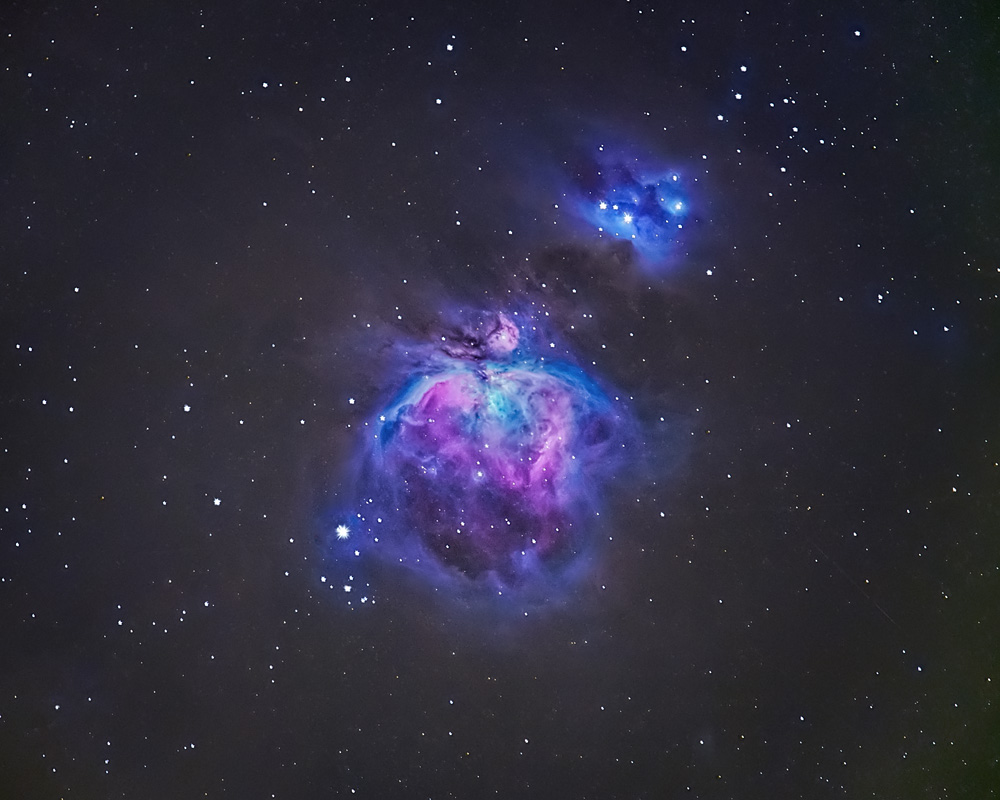
Orion_Nebula_20200219_dw.jpg
 

JimFox

Moderator
Staff member
Beautiful result.

Does your computer make groaning sounds while startracker is removing the stars? :D
Thanks Alan!

That's Starnet++ that removes the stars. Actually I think I make more noise while I star at the screen watching the incredibly slow progress bar on it.:oops:
 

Colorado CJ

Well-Known Member
Wow! Now that is how you do it!

Excellent image Jim. You've captured tons of detail and dust in this image. AND that is with just 20 minutes total integration!

Yeah, Starnett is pretty slow, but it is the best made so far for removing stars. There are a few Photoshop actions that do it as well, which are much quicker, but you lose so much detail using them that it is not a real option.

So how did it feel while seeing this image come to life? Kind of addicting, isn't it :)?
 

Amy Earl

Well-Known Member
Wow, that came out awesome! I didn't know that this kind of photo could be done without a telescope. Interesting. I guess it requires a pretty dark sky though (low light pollution).
 

JimFox

Moderator
Staff member
Wow! Now that is how you do it!

Excellent image Jim. You've captured tons of detail and dust in this image. AND that is with just 20 minutes total integration!

Yeah, Starnett is pretty slow, but it is the best made so far for removing stars. There are a few Photoshop actions that do it as well, which are much quicker, but you lose so much detail using them that it is not a real option.

So how did it feel while seeing this image come to life? Kind of addicting, isn't it :)?
Thanks so much Andrew! The details really popped out on this one. It's fun to see the improvements from one session to the next.

And yeah, it's pretty addicting. It reminds me I think a bit of the old film days when we would take our photos blindly, and not see any of the photo magic until we started to develop our prints in the various chemical baths. It's a bit like magic watching the image come alive.

Maybe for next Christmas I will upgrade a bit and get a mount that I can use a guide scope on. My little $500 SkyGuider Pro is awesome, and so extremely portable but it limits me to perhaps a dozen or so objects that I can accurately find and align on by eye. These are fun to capture and image, but I am thinking by next year I will want to capture some new fainter and or smaller objects in the sky and I think a mount with a GoTo and a Guide Scope will help in that next step.

The only thing that I don't really like is the need then for a computer/laptop when using those mounts. I really enjoy the flexibility and freedom I have with my current set up.

Thanks for all of your encouragement.
 

JimFox

Moderator
Staff member
Wow, that came out awesome! I didn't know that this kind of photo could be done without a telescope. Interesting. I guess it requires a pretty dark sky though (low light pollution).
Thanks Amy! It's so much fun to do. I am having to plot more trips looking for clear skies, where before I would be looking for partly cloudy skies. :)

When I first was interested in this, I thought I would need a telescope too! When I found out that I could used my long lens (Tamron 150-600mm) in place of a telescope I realized that I didn't need to spend tons of money to get started in Deep Space Photography. I just needed a Tracker that could keep my camera and lens aligned in the right place in the sky. The SkyGuider Pro by iOptron is the best of the best I think for doing that while not costing an arm and a leg. It was only $429 and then another $100 for a solid tripod that matches with it.

I am really enjoying this. In time I think I will upgrade the parts slowly, but for now, I will just enjoy what I can get and keep improving my techniques and knowledge.

Dark skies for sure help, no doubt. But I have seen lot's of video guides from people that live in very populated areas and still can capture great Deep Space Photos, the tracking allows you to do that. Colorado CJ (Andrew) lives in a populated area in Colorado and shoots all of his awesome photos from his backyard. Now of course, I live in the middle of the Los Angeles area so it would be very hard for me to do it here, along with limited sky views from my house. But it's only a 2 hour drive for me to go to Joshua Tree where I can then shoot with wide open skies and some pretty dark skies.
 

Amy Earl

Well-Known Member
Thanks Amy! It's so much fun to do. I am having to plot more trips looking for clear skies, where before I would be looking for partly cloudy skies. :)

When I first was interested in this, I thought I would need a telescope too! When I found out that I could used my long lens (Tamron 150-600mm) in place of a telescope I realized that I didn't need to spend tons of money to get started in Deep Space Photography. I just needed a Tracker that could keep my camera and lens aligned in the right place in the sky. The SkyGuider Pro by iOptron is the best of the best I think for doing that while not costing an arm and a leg. It was only $429 and then another $100 for a solid tripod that matches with it.

I am really enjoying this. In time I think I will upgrade the parts slowly, but for now, I will just enjoy what I can get and keep improving my techniques and knowledge.

Dark skies for sure help, no doubt. But I have seen lot's of video guides from people that live in very populated areas and still can capture great Deep Space Photos, the tracking allows you to do that. Colorado CJ (Andrew) lives in a populated area in Colorado and shoots all of his awesome photos from his backyard. Now of course, I live in the middle of the Los Angeles area so it would be very hard for me to do it here, along with limited sky views from my house. But it's only a 2 hour drive for me to go to Joshua Tree where I can then shoot with wide open skies and some pretty dark skies.
Awesome! I've dabbled in astrophotography a little and would definitely appreciate the flexibility that a startracker could provide. I realize that would allow me to do longer exposures and this capture more interesting things in spite of sub-optimal light conditions - cool!
 

JimFox

Moderator
Staff member
Awesome! I've dabbled in astrophotography a little and would definitely appreciate the flexibility that a startracker could provide. I realize that would allow me to do longer exposures and this capture more interesting things in spite of sub-optimal light conditions - cool!
There are lots of good trackers out there now, but to me the SkyGuider Pro is the cream of the crop if you decide to get one.
 

Mike Lewis

Staff Member
Jim,

Just catching this one for the first time now.

M42 is a famous astro target for a reason, and you have done it justice here. Lots of nice detail and your focal length choice that has allowed to include the Running Man Nebula makes this even more appealing. Things look just a teensy bit too hot in the purple and blue, but that could be my monitor, as I am currently struggling to get it calibrated in a way that makes sense.

ML
 
Top Bottom