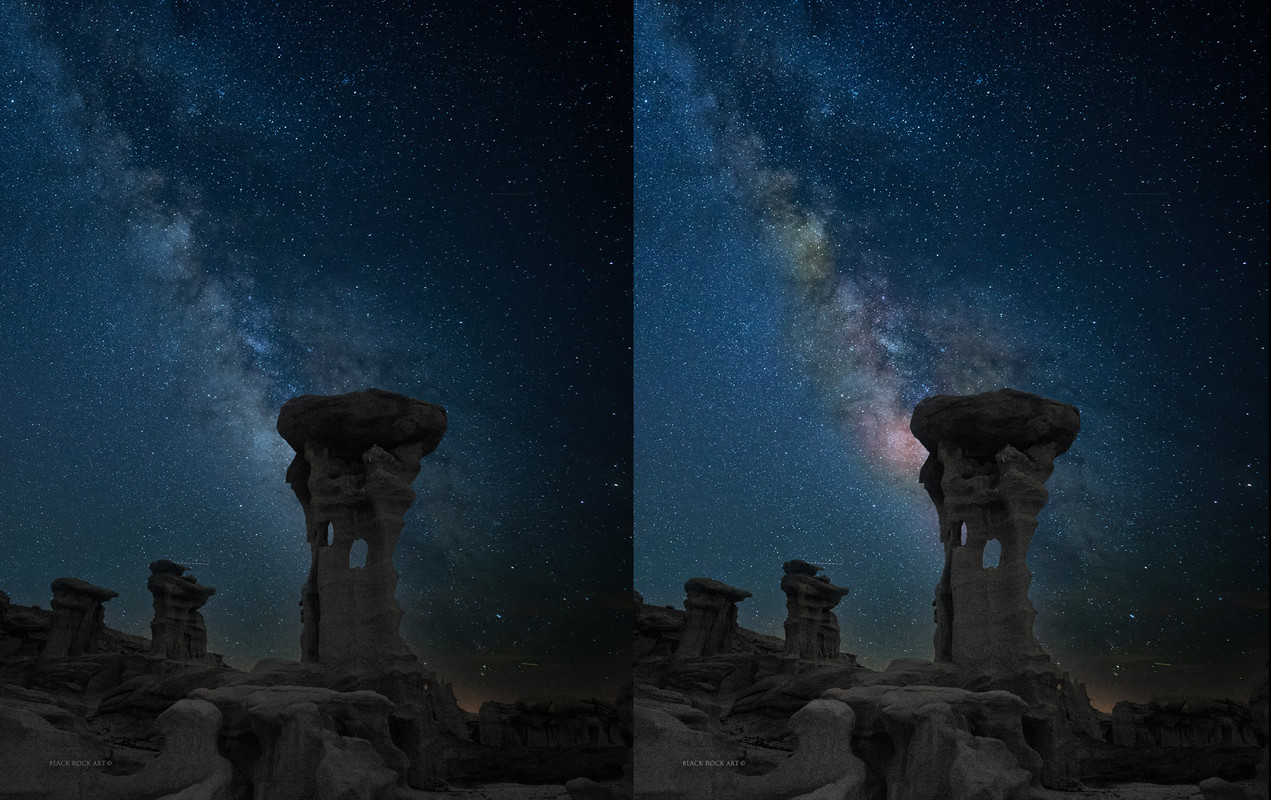
Week Sep 10 Wide Field Astro Night Photography Tones

Hi y'all

Right now I am in Farmington for a long overdue trip.

The weather over the last two nights has been good, I got some nice pictures.

While waiting for the long exposure, I came to think: What is a good color tone for wide-field astrophotography?

When I looked at the photos I had taken during the last 10 years, I noticed immediately my penchant for a warmer Milky Way core.

One night I had a change of heart suddenly: How about a cooler night sky?

Do you prefer a warmer night sky or a cooler tone ?

Oliver
 

JimFox

Moderator
Staff member
Hey Oliver,

That's a great thought.

I go for a cooler White Balance. I have noticed in shooting my night time Timelapse's, that with the camera in Auto WB, the sky will be cooler in the early evening and the early morning, but the late night WB will be warmer. Now if there is a lot of green Airglow in the sky, it will tend to keep it cooler.

Here is my guide. I will cool down the White Balance but I keep a very close eye on the stars. If the stars also start turning blue, I have adjusted it too much. So keeping the stars White is my barometer to knowing if I adjusted it too much.

And don't forget to adjust the Tint. You need to also adjust the Tint to get the right shade of Blue.

It takes a very light touch to the WB and Tint sliders.

Also on that note, pushing the Vibrance slider up is also a good way as it pushes the blue color above all others. So adjusting your Vibrance and Saturation sliders also affects the Tone/WB of the sky. So it's part of the equation also.
 
Hey Oliver,

That's a great thought.

I go for a cooler White Balance. I have noticed in shooting my night time Timelapse's, that with the camera in Auto WB, the sky will be cooler in the early evening and the early morning, but the late night WB will be warmer. Now if there is a lot of green Airglow in the sky, it will tend to keep it cooler.

Here is my guide. I will cool down the White Balance but I keep a very close eye on the stars. If the stars also start turning blue, I have adjusted it too much. So keeping the stars White is my barometer to knowing if I adjusted it too much.

And don't forget to adjust the Tint. You need to also adjust the Tint to get the right shade of Blue.

It takes a very light touch to the WB and Tint sliders.

Also on that note, pushing the Vibrance slider up is also a good way as it pushes the blue color above all others. So adjusting your Vibrance and Saturation sliders also affects the Tone/WB of the sky. So it's part of the equation also.
Hi Jim.

My default night sky setting is 3800K on Sony cameras, oddly, Lightroom ACR always sets it to 3850K; I try not to use Auto WB for the reason of city light pollution, in the Bay Area, the effect can be 500K off.

In night photos, I find vibrance has a greater impact on the overall tone.

Here is a sample of Bisti Wildness shot I took a few days ago:

The storm clouds moved in almost as soon as the sky became dark.

Oliver

_B4C2612AlientThroneFB.jpg
 

Peano

Member
When I looked at the photos I had taken during the last 10 years, I noticed immediately my penchant for a warmer Milky Way core.

One night I had a change of heart suddenly: How about a cooler night sky?

Do you prefer a warmer night sky or a cooler tone ?
How about both? I agree with the preference for a warmer MW core, but I also like the idea of a cooler surrounding sky. So let's hear it for selective editing! I would shoot raw so the camera WB settings don't matter. Then globally cool the whole sky (in ACR or Photoshop) and selectively warm up the Milk Way core.


AlanLichty

Moderator
How about both? I agree with the preference for a warmer MW core, but I also like the idea of a cooler surrounding sky. So let's hear it for selective editing! I would shoot raw so the camera WB settings don't matter. Then globally cool the whole sky (in ACR or Photoshop) and selectively warm up the Milk Way core.
That's a really nice looking result.
 

JimFox

Moderator
Staff member
Hey Peano,

That's a great result and a great tip. And thanks so much for the sample edit, those are handy to really visualize the tip.
 
Top Bottom