Vela Supernova Remnant

CRTAstro

Well-Known Member
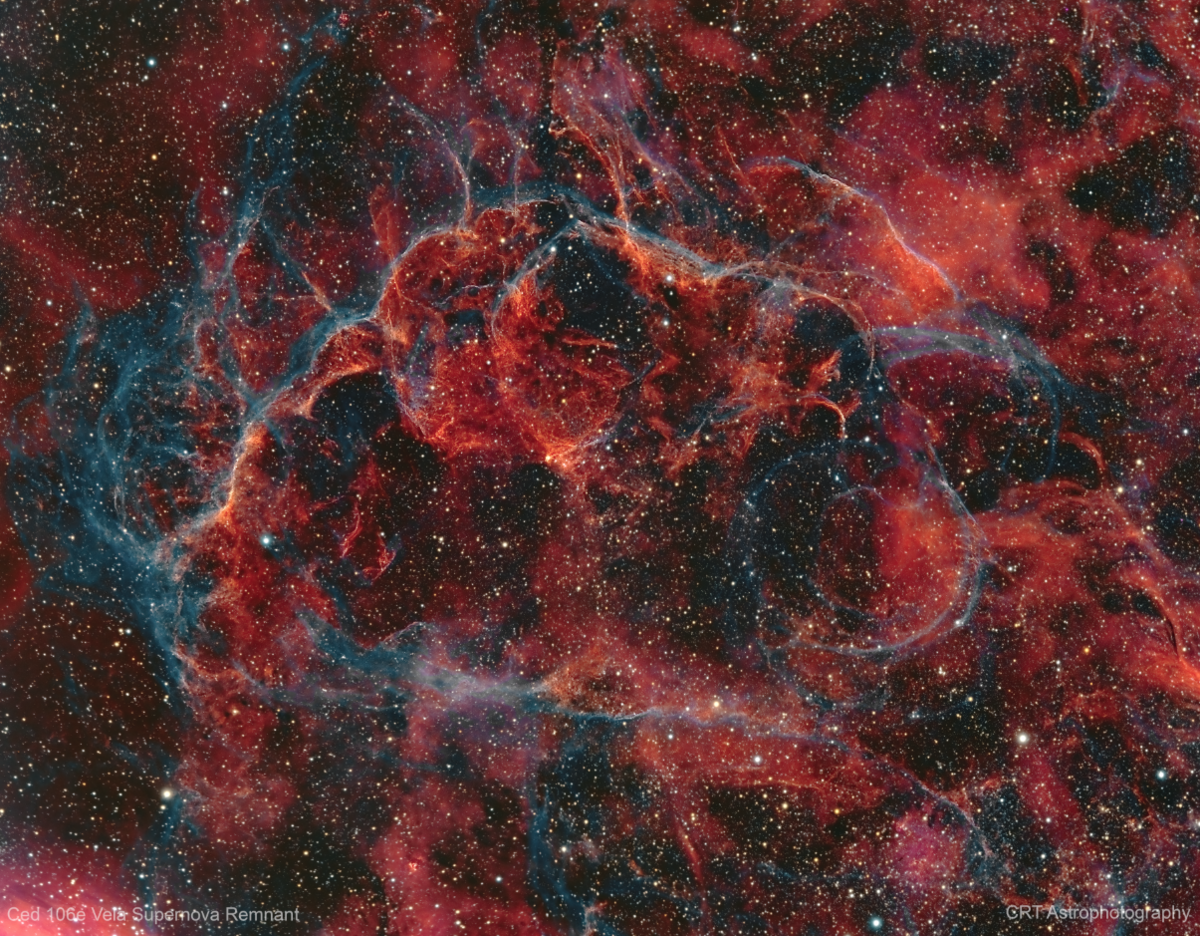
Ced 106e is a section of the vast Vela Supernova Remnant shot in narrowband HSO. The supernova exploded approximately 11000-12000 years ago and is about 800 light-years away. The region has always interested me with its weird shapes and formations, one reminding me of a favourite Star Wars character.
Possibly the last target in my current spell of wide-field imaging. Shazza needs a rest.
134 x 600s subs shot @-10C spread across 6 nights for a total integration time of 22.3 hrs.

For a higher resolution visit: https://www.astrobin.com/hgtvni/

Sharpstar 61EDPH II APO Triplet Refractor
Sharpstar 0.8x Flattener/Reducer
Skywatcher NEQ6 Pro Hypertuned by Astronomy Academy Perth
Primaluce Sesto Senso2 Electronic Focuser
ZWO ASI2600MM Pro Cooled Camera
ZWO Off-Axis Guider
ZWO ASI290MM Mini Guide Camera
ZWO Electronic Filter Wheel
Antlia 3nm Pro NB 36mm unmounted filters
Rollon rolloff modified shed observatory
Bortle 5
Data acquisition software: NINA Astronomy Software
Processing software: PixInsight and Photoshop CC

http://instagram.com/crt_astrophotography
1642823118185.png
 

JimFox

Moderator
Staff member
Wall to wall Nebulosity! :)

I sure like how this fills the screen. The lace effect of the blue going through the image is really awesome. It reminds me of the Quantam Realm in Antman. :)

A question. What's considered wide field in Astro? I see the term, and I have an idea, but coming from Landscape Photography where wide is 14mm, in relation to that this isn't wide. But in regards to Astro, I have learned it's different, but not sure what would be considered wide field.
 

CRTAstro

Well-Known Member
Wall to wall Nebulosity! :)

I sure like how this fills the screen. The lace effect of the blue going through the image is really awesome. It reminds me of the Quantam Realm in Antman. :)

A question. What's considered wide field in Astro? I see the term, and I have an idea, but coming from Landscape Photography where wide is 14mm, in relation to that this isn't wide. But in regards to Astro, I have learned it's different, but not sure what would be considered wide field.
Cheers Jim ! Always appreciate your comments !

Haha I guess I should have placed wide-field in quotes as it's wider than what I would get with my newt (maybe the 2 blobs near top of centre)...so technically not true wide-field. Some say 2deg and wider would def fall into that category.

Here's a good CN thread:
https://www.cloudynights.com/topic/648585-wide-field-vs-deep-sky/
 

JimFox

Moderator
Staff member
Cheers Jim ! Always appreciate your comments !

Haha I guess I should have placed wide-field in quotes as it's wider than what I would get with my newt (maybe the 2 blobs near top of centre)...so technically not true wide-field. Some say 2deg and wider would def fall into that category.

Here's a good CN thread:
https://www.cloudynights.com/topic/648585-wide-field-vs-deep-sky/
Ha ha, thanks for that link! I am glad I am not the only confused person. :)

Though I don't think I have any better idea what it is since with my noob status in Astro I have no idea what 2 degrees is. I guess coming from SLR/DSLR background, I think in terms of a 24mm lens, or a 50mm lens or a 400mm lens, so 2 degrees isn't something I can relate to a lens length. Is it the size of the object being captured? Or does it relate to the lens or scope being used?

Thanks for humoring my ignorance. :)
 

Mike Lewis

Staff Member
Ha ha, thanks for that link! I am glad I am not the only confused person. :)

Though I don't think I have any better idea what it is since with my noob status in Astro I have no idea what 2 degrees is. I guess coming from SLR/DSLR background, I think in terms of a 24mm lens, or a 50mm lens or a 400mm lens, so 2 degrees isn't something I can relate to a lens length. Is it the size of the object being captured? Or does it relate to the lens or scope being used?

Thanks for humoring my ignorance. :)
Jim,

It refers to FOV. Head over to Astronomy.Tools and use their FOV calculator and you can start to see what the FOV of certain setups (including yours) are. very helpful tool.

ML
 

Mike Lewis

Staff Member
That is the bomb! Love this area - wish it was more visible from here. The intricate detail and interacting colors are mesmerizing at any scale.

How are you liking the little Sharpstar OTA? I am starting to dream about replacing my 8" Edge SCT with the new Sharpstar SCA260. Pretty intriguing at 1300mm and native f/5. Not cheap, and maybe a little too tricky to keep collimated. And only an option if I can successfully get my used Paramount ME online. That will be a summer project after this next impending remote session with my 4" refractor is over. Excited to be about to start taking some of my own data again!

Great work on this one!

ML
 

Jameel Hyder

Moderator
Staff member
Wall to wall Nebulosity! :)

I sure like how this fills the screen. The lace effect of the blue going through the image is really awesome. It reminds me of the Quantam Realm in Antman. :)

A question. What's considered wide field in Astro? I see the term, and I have an idea, but coming from Landscape Photography where wide is 14mm, in relation to that this isn't wide. But in regards to Astro, I have learned it's different, but not sure what would be considered wide field.
Jim, your 600mm has a field of view of 3.4 degrees. So a 2 degree would be in the vicinity of ~1200mm.
 

CRTAstro

Well-Known Member
Ha ha, thanks for that link! I am glad I am not the only confused person. :)

Though I don't think I have any better idea what it is since with my noob status in Astro I have no idea what 2 degrees is. I guess coming from SLR/DSLR background, I think in terms of a 24mm lens, or a 50mm lens or a 400mm lens, so 2 degrees isn't something I can relate to a lens length. Is it the size of the object being captured? Or does it relate to the lens or scope being used?

Thanks for humoring my ignorance. :)
Hi Jim, here's another link for you:

https://lovethenightsky.com/what-is-a-field-of-view-in-astronomy-and-why-is-it-useful/
 

CRTAstro

Well-Known Member
That is the bomb! Love this area - wish it was more visible from here. The intricate detail and interacting colors are mesmerizing at any scale.

How are you liking the little Sharpstar OTA? I am starting to dream about replacing my 8" Edge SCT with the new Sharpstar SCA260. Pretty intriguing at 1300mm and native f/5. Not cheap, and maybe a little too tricky to keep collimated. And only an option if I can successfully get my used Paramount ME online. That will be a summer project after this next impending remote session with my 4" refractor is over. Excited to be about to start taking some of my own data again!

Great work on this one!

ML
Thanks Mike ! I'm lovin the little refractor! So easy to use and can carry anywhere when in its little pelican-type case.

I have a friend who bought the SCA260 a couple of months ago and I think he likes it. His previous OTA was the 10" F4 newt like mine but I think he got fed up tinkering with it (ie collimation). If you'd like to see his images look up 'Reggie' on Astrobin. Imho I still think the newt offers a better quality image.
 

Mike Lewis

Staff Member
Thanks Mike ! I'm lovin the little refractor! So easy to use and can carry anywhere when in its little pelican-type case.

I have a friend who bought the SCA260 a couple of months ago and I think he likes it. His previous OTA was the 10" F4 newt like mine but I think he got fed up tinkering with it (ie collimation). If you'd like to see his images look up 'Reggie' on Astrobin. Imho I still think the newt offers a better quality image.
Very good info - thanks! Well I am looking for something with more magnification than a typical newt - at least 1200mm I think. So that is why I was thinking of the SCA260. I also need a fair amount of backfocus to accommodate the ONAG which I like to use. I wish ASA still made those large imaging Newtonians, as I do agree a Newtonian can have wonderful image quality. Do you know of any imaging Newtonians that might be in the 1200 - 1400mm range at no more cost than the SCA260? I am still looking around at options. I could also stick with my Edge 800 and a reducer, or perhaps step up to the 9.25 inch edge and reducer. But not sure on the image quality on those either. I have been spoiled by the results I get with my 4 inch refractor :)

ML
 
Top Bottom