

Douglas Sherman
Staff
In the 1960's when I was a graduate student at USC in geology I visited the Racetrack in Death Valley and became intrigued by how these things moved. The prevailing hypotheses were: 1) the wind blew them when the surface was slick after a rain (few believed that was right); 2) after a rain the water on the playa froze trapping the rocks in the ice which provided a greater surface for the wind and made it easier for the wind to work ( a lot of people believed that); and 3) rocks that tumbled down from the adjacent slopes would have enough momentum to slide across a wet clay surface (obviously wrong based on evidence.
The surface was indeed very slick when wet. One time a friend of mine and I were there after a rain and there was a small patch of wet clay along the shore so we decided to test how slick it was. We drove a VW Bus onto the surface, shut off the engine, put on the emergency brake, got out and proceeded to push the bus across the surface easily, slipping and sliding as we went a short distance. No tracks were hurt during this process along the edge of the playa.
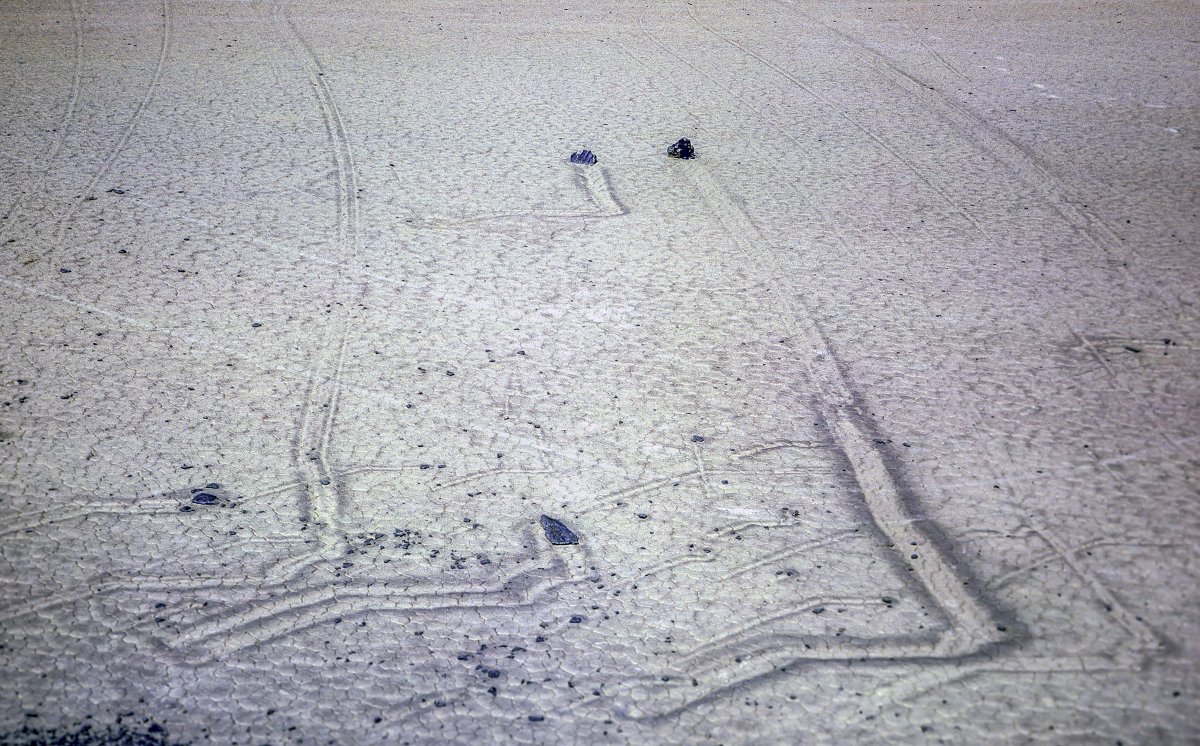
I visited the Racetrack many times and kept up with the literature. One day I saw the situation shown below. The rocks at one end of the playa had the same movement signatures but they were of different lengths. It was immediately evident to me that the changes in direction were a function of shifting wind directions and that the higher the rock projected above the surface the farther the wind could blow it. The ice hypothesis was discarded because of the different lengths of the tracks. If the rocks were stuck in ice their tracks would be the same lengths with the exception that the farther they were from an axis of rotation the longer their tracks would be.
I thought about publishing my findings but decided "who would really care" and left it at that. About five years later, Bob Sharp, an excellent geomorphologist from Cal Tech figured it out and published his results. The popular press was fascinated with this discovery and it was in all of the major newspapers.
Oh well... sometimes you make mistakes.
Here is the image. It is nothing special but it served a purpose. It was hand held, shot at f8, 125th of a second on Kodachrome 25.
The surface was indeed very slick when wet. One time a friend of mine and I were there after a rain and there was a small patch of wet clay along the shore so we decided to test how slick it was. We drove a VW Bus onto the surface, shut off the engine, put on the emergency brake, got out and proceeded to push the bus across the surface easily, slipping and sliding as we went a short distance. No tracks were hurt during this process along the edge of the playa.
I visited the Racetrack many times and kept up with the literature. One day I saw the situation shown below. The rocks at one end of the playa had the same movement signatures but they were of different lengths. It was immediately evident to me that the changes in direction were a function of shifting wind directions and that the higher the rock projected above the surface the farther the wind could blow it. The ice hypothesis was discarded because of the different lengths of the tracks. If the rocks were stuck in ice their tracks would be the same lengths with the exception that the farther they were from an axis of rotation the longer their tracks would be.
I thought about publishing my findings but decided "who would really care" and left it at that. About five years later, Bob Sharp, an excellent geomorphologist from Cal Tech figured it out and published his results. The popular press was fascinated with this discovery and it was in all of the major newspapers.
Oh well... sometimes you make mistakes.
Here is the image. It is nothing special but it served a purpose. It was hand held, shot at f8, 125th of a second on Kodachrome 25.


