

JaneG
Well-Known Member
Here's a little piece I have just written for my blog, simplified a little for the non photographers.
I was standing on the cliff edge near Land's End in December, looking out to the beautiful rock arch of Enys Dodnan. The granite rock was being beaten by the crashing waves created the high winds on the winter sea. My camera was locked onto a tripod and pointed towards the granite rocks. Although the light was bright I was able to make a few crucial adjustments to my kit by adding a neutral density filter onto the front of the lens and capture a few seconds of the world onto just 1 frame.
The image I made below reflects reality, it is just as real as my own real time human perception. Those moments existed but can never be perceived by humans in the way I had just captured. The slight blurring of the water provides an alternative view of the world and occurs because the camera reveals all the light experiences of those few seconds melded into one. The waves could have been captured in ‘human time’ such as a shutter speed of 1/10th second (apparently we humans can perceive 10 to 12 separate images per second). This is how we know the world and recognise our ‘normal’. I could have taken an image with an even smaller slice of experience, faster than ability of the human eye and brain to perceive (say a 1/100 or 1/1000 of a second) and I would have captured the waves in all their detail, with each individual wave in sharp focus.
Our ability to resolve changes in our environment depends on how rapidly our nervous system processes sensory information. It has been suggested that our ability to resolve these changes also affects our preception of time. If a dragon fly resolved its world in a similar way to humans, I don’t think it would last very long in ‘the wild’ and would be snapped up by a fast moving predator. Our perception of changes in our environment, has evolved out of necessity, it is not arbitrary but rather it is finely tuned by how we are required to interact with our surroundings.
The amazing thing, is that humans are the first creatures in the world to be able to manipulate our resolution of perception and the wonderful thing about using a camera is that it provides us with the ability to discover these different realities.
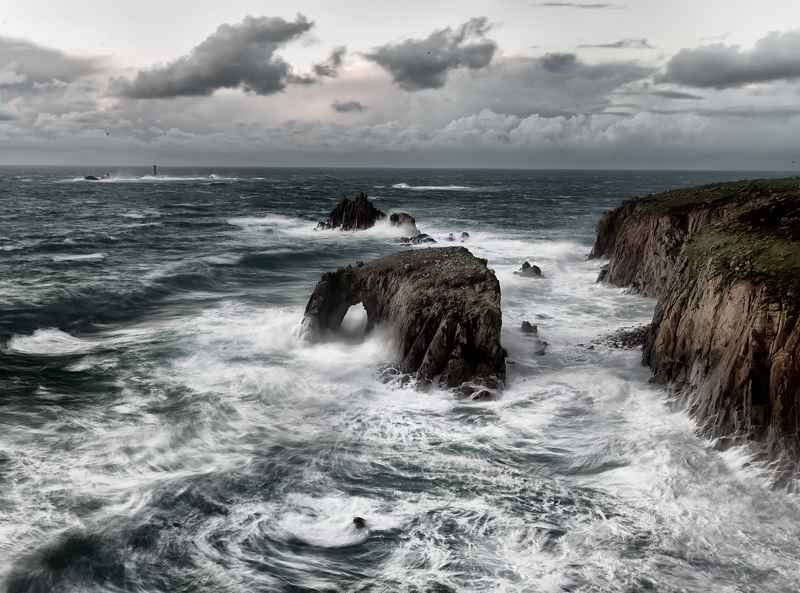
I was standing on the cliff edge near Land's End in December, looking out to the beautiful rock arch of Enys Dodnan. The granite rock was being beaten by the crashing waves created the high winds on the winter sea. My camera was locked onto a tripod and pointed towards the granite rocks. Although the light was bright I was able to make a few crucial adjustments to my kit by adding a neutral density filter onto the front of the lens and capture a few seconds of the world onto just 1 frame.
The image I made below reflects reality, it is just as real as my own real time human perception. Those moments existed but can never be perceived by humans in the way I had just captured. The slight blurring of the water provides an alternative view of the world and occurs because the camera reveals all the light experiences of those few seconds melded into one. The waves could have been captured in ‘human time’ such as a shutter speed of 1/10th second (apparently we humans can perceive 10 to 12 separate images per second). This is how we know the world and recognise our ‘normal’. I could have taken an image with an even smaller slice of experience, faster than ability of the human eye and brain to perceive (say a 1/100 or 1/1000 of a second) and I would have captured the waves in all their detail, with each individual wave in sharp focus.
Our ability to resolve changes in our environment depends on how rapidly our nervous system processes sensory information. It has been suggested that our ability to resolve these changes also affects our preception of time. If a dragon fly resolved its world in a similar way to humans, I don’t think it would last very long in ‘the wild’ and would be snapped up by a fast moving predator. Our perception of changes in our environment, has evolved out of necessity, it is not arbitrary but rather it is finely tuned by how we are required to interact with our surroundings.
The amazing thing, is that humans are the first creatures in the world to be able to manipulate our resolution of perception and the wonderful thing about using a camera is that it provides us with the ability to discover these different realities.
Last edited:


