

Mike Lewis
Staff Member
So I have shot lunar eclipses before, and as a general rule I find them to be one of those events that the camera does not do justice to. many images of the fully eclipsed moon just look like somewhat OOF (due to motion blur of the moon itself) images with wonky white balance (because of the accurate reddish color.) So this time I decided to try something new for me - try to make a composite image using HDR techniques that showed some detail in both the bright and dark portions of the moon. This idea proved to be largely a failure, but was a good learning experience, and along the way I did manage some serviceable moon images.
Lessons Learned
Here are my keepers.
Full moon prior to the eclipse beginning (probably the best shot of the lot...)

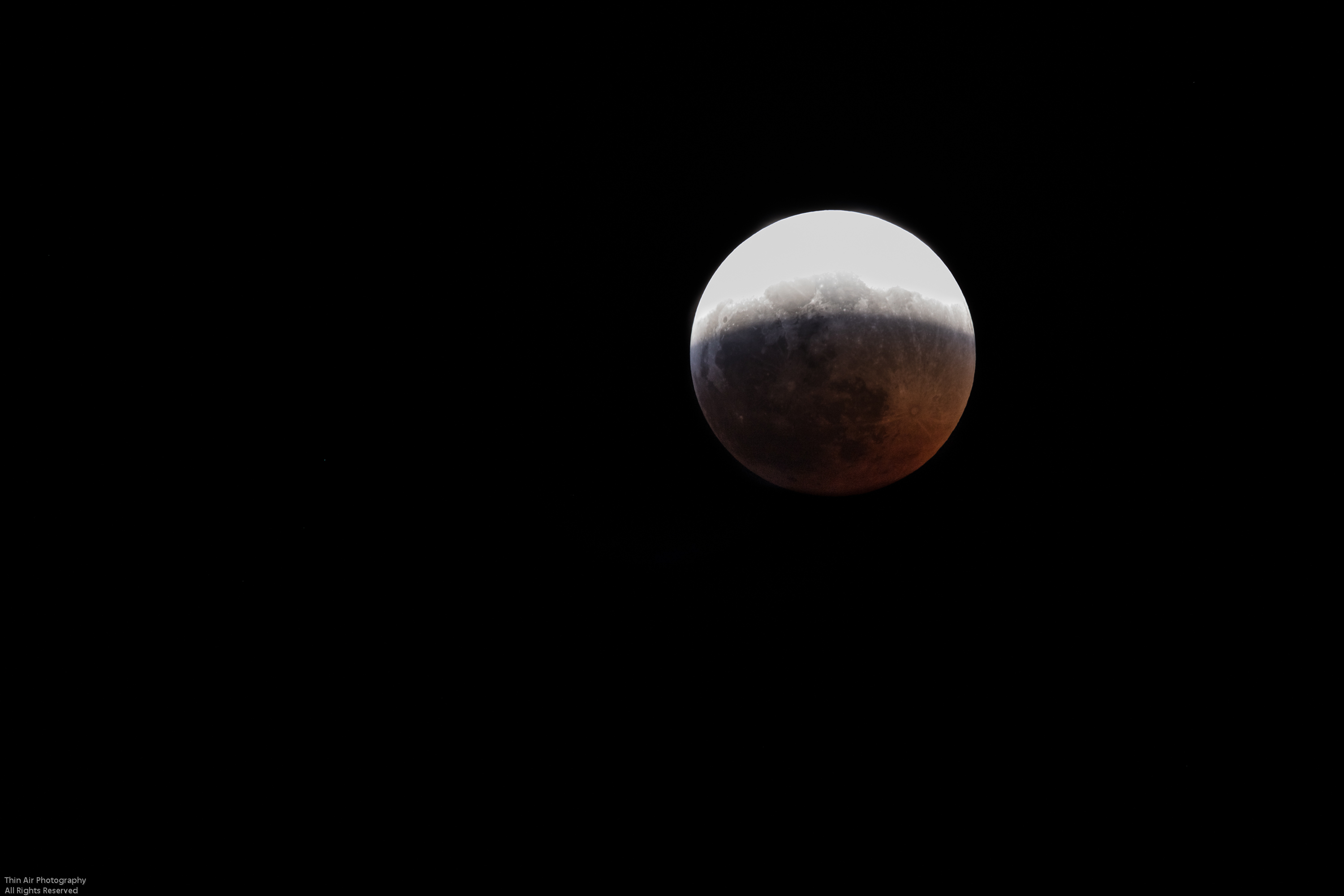
Partially eclipsed moon, exposed for detail in the light portion. The location and shape of the transition shows this to obviously be something other than a day/night terminator.

The best result (from a heavily edited single frame instead of a stack) version of the kind of image I was after. Not very good, but shows the potential if tracked images could be taken to reduce the motion blur effetcs...
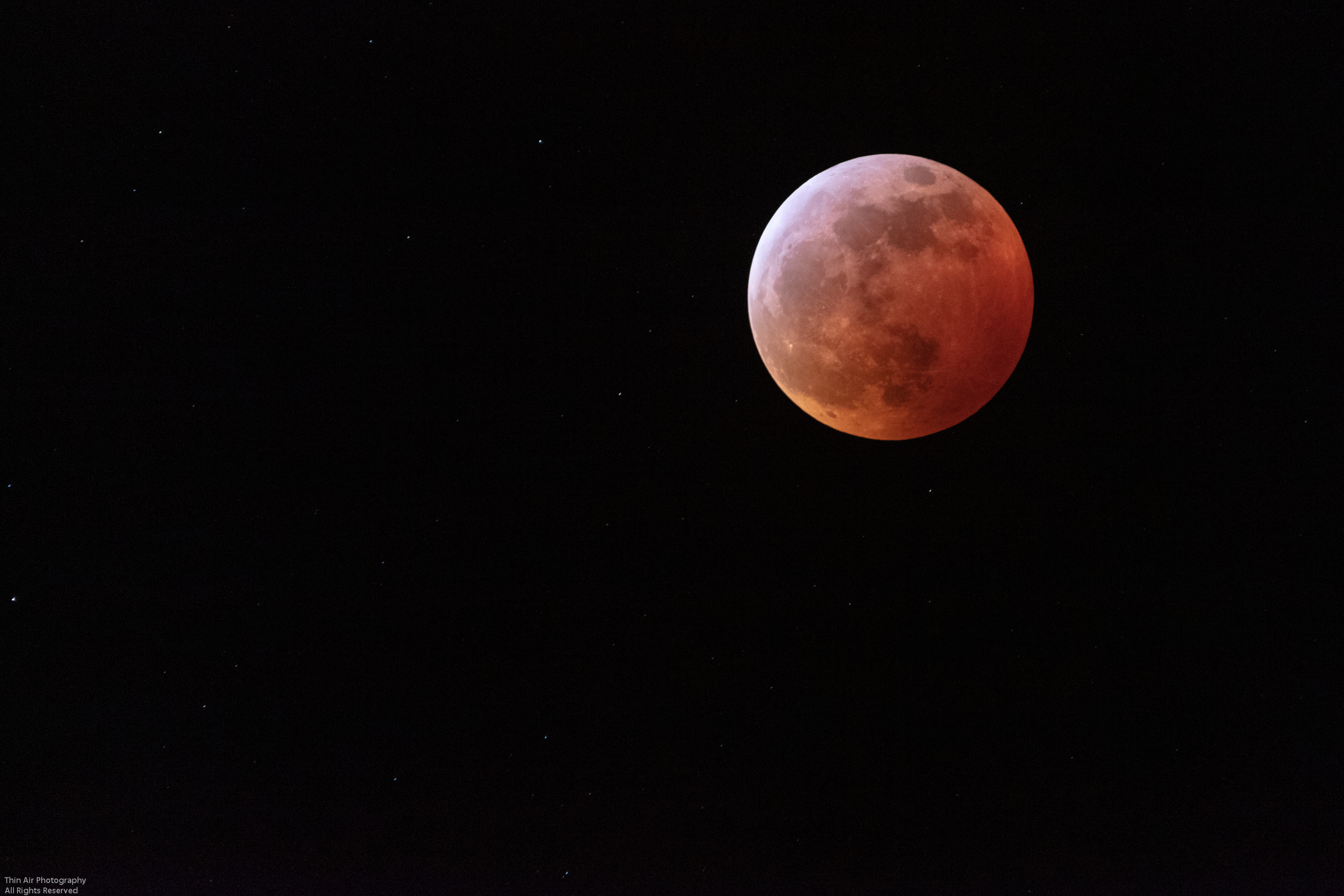
A total eclipse image, shot all the way up at 3200 ISO (not a good place to be with the 5DSr) in order to try to minimize motion blur. The stars are still trailed at 100% at 600mm. But a fun shot anyway.
I will return to this idea in the future, hopefully with a camera that has a little less noise and with a tracked mount.
Any comments or critiques very welcome.
ML
Lessons Learned
- My tracking mount is currently off-site in preparation for a semi-permanent mounting that should allow me to shoot deep sky astro stuff more often and accumulate longer integration times on specific targets. So I used a fix tripod. This proved to be a poor choice, as at my focal length of 600mm, even a 1 second image was blurring the moon due to the moon's motion across the sky. So for a future version of this attempt, I will use my tracking mount.
- I already knew the 5DSr is not a great high ISO camera. This was borne out in the higher ISO totally eclipsed images I shot trying to keep the shutter speed down to allow for less motion blur.
- This was the first try at using my Sigma 150-600mm Contemporary lens for any astro shots. Accounting for some motion blur and the inevitable seeing degradation prevalent this close to the mountains I thought it actually performed rather well.
- Using a gimbal mount for this type of shooting is a great improvement over a ballhead, especially with a long optic like the Sigma 150-600 at 600mm.
- My cold resistance is a rapidly deteriorating spec as I get older

Here are my keepers.
Full moon prior to the eclipse beginning (probably the best shot of the lot...)
LRCC_LunarEclipse_20190120_FW_TAP32479
Full moon, prior to total lunar eclipse, 2019-01-20
Partially eclipsed moon, exposed for detail in the light portion. The location and shape of the transition shows this to obviously be something other than a day/night terminator.
LRCC_LunarEclipse_20190120_FW_TAP32556
Partially eclipsed moon, total lunar eclipse, 2019-01-20
The best result (from a heavily edited single frame instead of a stack) version of the kind of image I was after. Not very good, but shows the potential if tracked images could be taken to reduce the motion blur effetcs...
LRCC_LunarEclipse_20190120_FW_TAP32593
partially eclipsed moon, total lunar eclipse, 2019-01-20
A total eclipse image, shot all the way up at 3200 ISO (not a good place to be with the 5DSr) in order to try to minimize motion blur. The stars are still trailed at 100% at 600mm. But a fun shot anyway.
I will return to this idea in the future, hopefully with a camera that has a little less noise and with a tracked mount.
Any comments or critiques very welcome.
ML


