Meteorology Monday

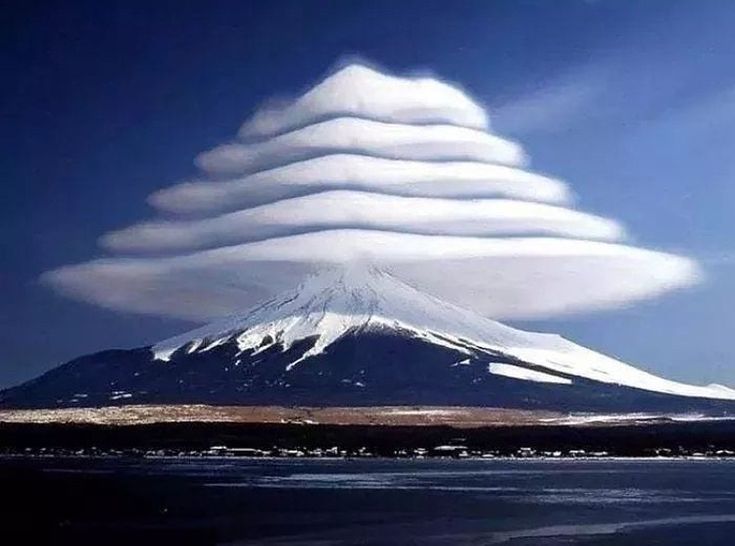
It is again time for some cloud images. Last week we did altocumulus. Let's do a popular variation of that cloud group. Today we will do altocumulus lenticularis. These clouds typically form over the tops of high mountains, especially volcanoes. These are caused by strong winds being uplifted over the mountains which then form waves. The clouds form in the crest of the wave where it is cold enough to cause condensation. The air is only cold enough to condense in the crest of the waves and as soon as it passes into a trough it warms up enough to make the cloud disappear. The result is a series of flying saucer shaped clouds which form directly above or on the lee side of the mountain (illustration below). Please pile on with your lenticular clouds or any others that you have.

lenticular cloud.jpg


This is one of my images of Mt. Rainier.

altocumulus lenticularis.jpg


This is someone else's image of Mt. Fuji. I can tell you exactly how something like this forms, but let's see if anyone can figure it out.
multiple lenticular clouds dover moount fuji.jpg


Lenticular clouds over the mountains on Maui.

maui lenticularis.jpg


Lenticular cloud on the east side of the Sierra's near Mojave, CA.

sierra lenticularis.jpg
 

AlanLichty

Moderator
I have a couple for this.

First up is Mt. Hood as seen from the Larch Mountain overlook:

HoodFromLarch3.jpg


I thought this one was cool since it almost looked like Mt. St. Helens was sending smoke signals. I believe these are called Detached Lenticulars. The peak just isn't quite high enough to hang on to its lenticulars so they start to form and never fully form before getting blown sideways.

MtStHelensJune.jpg


I think it's sad that Mt. St. Helens isn't big enough to be able to keep its lenticulars. Maybe we could start a GoFundMe page to help the volcano afford an upgrade to its top 😁
 

JimFox

Moderator
Staff member
It is again time for some cloud images. Last week we did altocumulus. Let's do a popular variation of that cloud group. Today we will do altocumulus lenticularis. These clouds typically form over the tops of high mountains, especially volcanoes. These are caused by strong winds being uplifted over the mountains which then form waves. The clouds form in the crest of the wave where it is cold enough to cause condensation. The air is only cold enough to condense in the crest of the waves and as soon as it passes into a trough it warms up enough to make the cloud disappear. The result is a series of flying saucer shaped clouds which form directly above or on the lee side of the mountain (illustration below). Please pile on with your lenticular clouds or any others that you have.

View attachment 53328

This is one of my images of Mt. Rainier.

View attachment 53325


This is someone else's image of Mt. Fuji. I can tell you exactly how something like this forms, but let's see if anyone can figure it out.

View attachment 53324

Lenticular clouds over the mountains on Maui.

View attachment 53327

Lenticular cloud on the east side of the Sierra's near Mojave, CA.

View attachment 53330
Wow Doug! Great examples! I am stumped on how the cone shaped ones over Mt Fuji were formed. Is that like a once in a lifetime shape do you think?
 

JimFox

Moderator
Staff member
I have a couple for this.

First up is Mt. Hood as seen from the Larch Mountain overlook:

View attachment 53332

I thought this one was cool since it almost looked like Mt. St. Helens was sending smoke signals. I believe these are called Detached Lenticulars. The peak just isn't quite high enough to hang on to its lenticulars so they start to form and never fully form before getting blown sideways.

View attachment 53333

I think it's sad that Mt. St. Helens isn't big enough to be able to keep its lenticulars. Maybe we could start a GoFundMe page to help the volcano afford an upgrade to its top 😁
Hey Alan, very cool photos! Your detached lenticulars don't quite look like lenticulars to me, but I guess I am more used to the Sierra Wave type of Lenticulars in the Eastern Sierra. It is cool how they look like smoke signals from 150 years ago.
 

AlanLichty

Moderator
Hey Alan, very cool photos! Your detached lenticulars don't quite look like lenticulars to me, but I guess I am more used to the Sierra Wave type of Lenticulars in the Eastern Sierra. It is cool how they look like smoke signals from 150 years ago.
They each form as a dome over the mountain and then drift upwards and away from the peak.
 
I have a couple for this.

First up is Mt. Hood as seen from the Larch Mountain overlook:

View attachment 53332

I thought this one was cool since it almost looked like Mt. St. Helens was sending smoke signals. I believe these are called Detached Lenticulars. The peak just isn't quite high enough to hang on to its lenticulars so they start to form and never fully form before getting blown sideways.

View attachment 53333

I think it's sad that Mt. St. Helens isn't big enough to be able to keep its lenticulars. Maybe we could start a GoFundMe page to help the volcano afford an upgrade to its top 😁
The lenticular clouds don't blow away from the mountain. As the air blows over the mountain, it creates a series of waves and the lenticular clouds form in each of the wave crests that are created. If you watch lenticular clouds, they never move from their location because they only form in the crests of the waves.
 
Wow Doug! Great examples! I am stumped on how the cone shaped ones over Mt Fuji were formed. Is that like a once in a lifetime shape do you think?
I believe these are lenticular if not please correct me.


View attachment 53334
Hey, Ben. On closer inspection it looks like there is an attempt to form lenticular clouds especially over the mountain on the far right of the image. Maybe the winds aren't quite strong enough to form decent waves. :)
 

Jameel Hyder

Moderator
Staff member
As to the Mt Fuji image, curious about what leads to this formation. If I had to guess, it would be Photoshop :)
 
Top Bottom