Home view Cave Nebula

Andy Nowlen

Well-Known Member
This is my version of the Cave Nebula in the constellation Cephus. I observe the extensive presence of the dark clouds and bok globules that make the shape what it is. The violent strength of the star formation areas central to the image really contrast and catch my eye.

I imaged this object during a new moon and from my house, that means shooting north/northeast which for me is away from town. It is just 2 hours of integration but the seeing and transparency were great. Overall I am happy with the result for now. I am less than a year into this hobby and mostly enjoying it. Although, sometimes, I think it is a troubleshooting hobby rather than an astrophotography hobby :>)


Scope = ES ED102mm f/7 @714
Camera = Asi533mcp
Mount = ioptron CEM40EC
guiding included, calibration frames included.
Astropixelprocessor, Pixinsight baby steps, Photoshop.
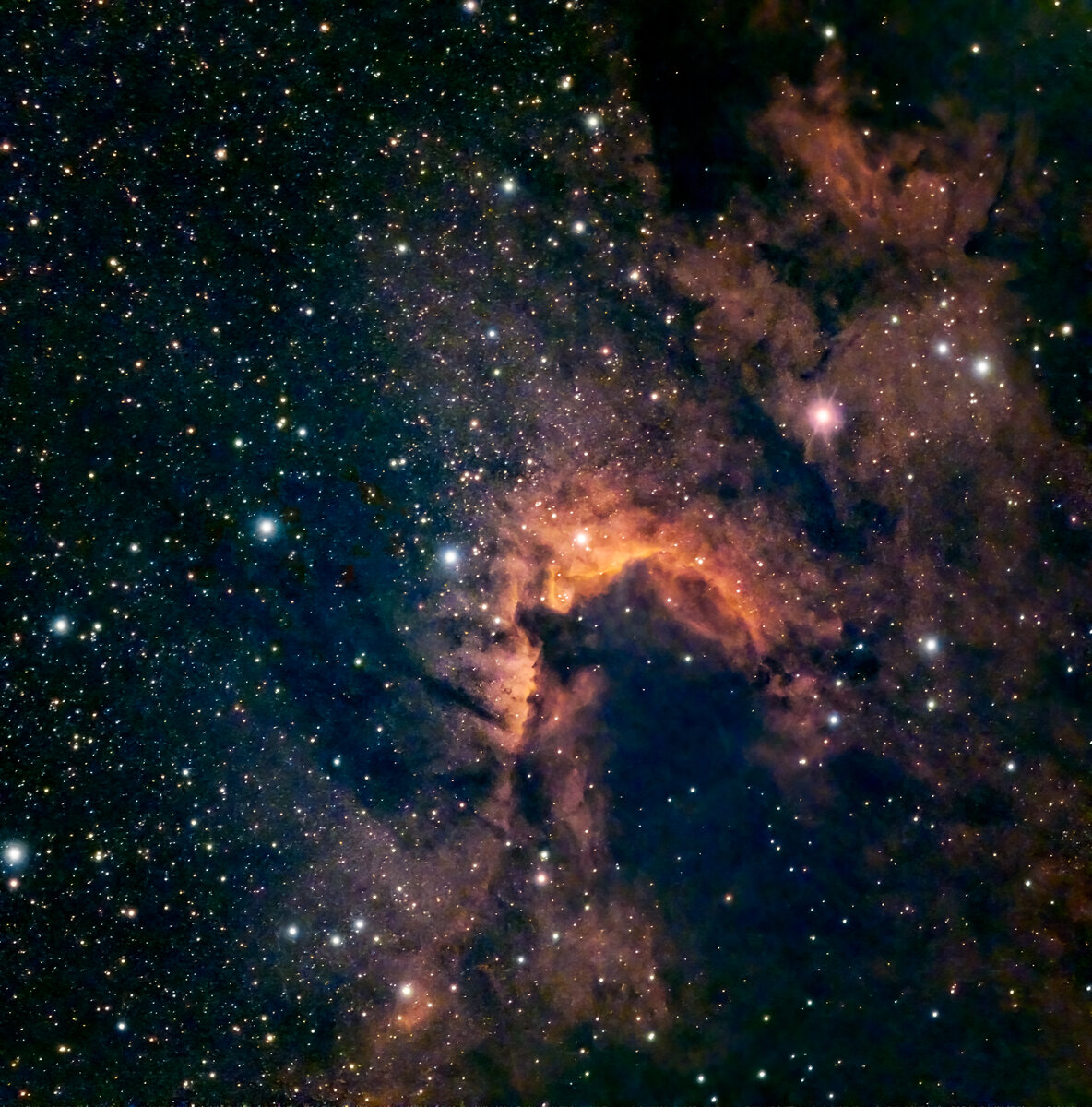

Cave Nebula SH2 155.jpg
 

AlanLichty

Moderator
Beautiful result. I am not an astro shooter but from what I have seen and read on here it is not an undertaking for the casual photographer.
 

JimFox

Moderator
Staff member
Hey Andy, this is really sweet. I have not captured the Cave Nebula yet. I like the detail you got in this, it looks pretty cool!

I was able to capture Deep Space images this last new moon while I was out shooting timelapse of the Perseids Meteor shower. It sure felt good! The month before I was trying out some new gear (ASIair Pro) and I don't think I ended up with a single image because I was too busy learning how to use it along with a guide scope.
 

Ben Egbert

Forum Helper
Staff member
Great stuff Andy, like Alan, I don't do astro, but I really like to view the results of all the great astro guys we have here.
 

Andy Nowlen

Well-Known Member
Thanks all. The Astro photography aspect of night sky viewing is both challenging and rewarding. I know what you mean about learning the ASIAIR. I am totally committed to that platform. For my level of experience it is perfect.
 
Last edited:

Mike Lewis

Staff Member
Andy,

What a nice result - looks like you are managing all the trade-offs of your home location to allow for some really nice results like this one! Lovely colors, detail, and a nice feeling of depth to this one. I am interested to hear about how you (and Jim) get on with the ASIAir. I have looked at that, although right now I am using a piece of gear that absolutely requires Windows to run so I am not likely to make the jump to it just yet. I am a big fan of ZWO though (my cameras is an ASI1600MM-Cool) so I have followed their development of that platform. I also own a number of Raspberry Pi computers (the hardware used in the ASIAir) so find it interesting for that reason as well.

And to your point, I completely agree - sometimes this hobby IS more about troubleshooting than it is about collecting data. My gear is currently down in AZ, being remotely controlled by me up here in CO. It isn't a true remote observatory but is set up outside and able to be used when my friend is down there at his house. It has worked very well, but not without a few strange problems, issues, and mysteries that have interrupted things. Astrophotography is like the original 'Wild West' days of personal computers, where you had to try to integrate all these 3rd party products together and then see where the hardware and software conflicts were to get the system up and running. Really an exercise in system engineering. I think astro hardware/software is a bit like that too at this point.

Keep pushing the boundaries on your forays into the post processing aspect of the hobby. Once one starts getting the acquisition side of things dialed in like you have, that is the next place where some additional time spent can make great gains in your results. I am pretty heavily into Pixinsight, with a dash of Photoshop and Lightroom mixed in. I can also recommend StarTools as another one to look at. It has a very unique workflow but can yield some very good results from some of the examples I have seen. I have mostly dabbled in it for my RGB stuff (not as much for narrowband) although i know it can do well on that too. They have a trial version I think and the price for the full up product is also very reasonable.

ML
 

Andy Nowlen

Well-Known Member
Andy,

What a nice result - looks like you are managing all the trade-offs of your home location to allow for some really nice results like this one! Lovely colors, detail, and a nice feeling of depth to this one. I am interested to hear about how you (and Jim) get on with the ASIAir. I have looked at that, although right now I am using a piece of gear that absolutely requires Windows to run so I am not likely to make the jump to it just yet. I am a big fan of ZWO though (my cameras is an ASI1600MM-Cool) so I have followed their development of that platform. I also own a number of Raspberry Pi computers (the hardware used in the ASIAir) so find it interesting for that reason as well.

And to your point, I completely agree - sometimes this hobby IS more about troubleshooting than it is about collecting data. My gear is currently down in AZ, being remotely controlled by me up here in CO. It isn't a true remote observatory but is set up outside and able to be used when my friend is down there at his house. It has worked very well, but not without a few strange problems, issues, and mysteries that have interrupted things. Astrophotography is like the original 'Wild West' days of personal computers, where you had to try to integrate all these 3rd party products together and then see where the hardware and software conflicts were to get the system up and running. Really an exercise in system engineering. I think astro hardware/software is a bit like that too at this point.

Keep pushing the boundaries on your forays into the post processing aspect of the hobby. Once one starts getting the acquisition side of things dialed in like you have, that is the next place where some additional time spent can make great gains in your results. I am pretty heavily into Pixinsight, with a dash of Photoshop and Lightroom mixed in. I can also recommend StarTools as another one to look at. It has a very unique workflow but can yield some very good results from some of the examples I have seen. I have mostly dabbled in it for my RGB stuff (not as much for narrowband) although i know it can do well on that too. They have a trial version I think and the price for the full up product is also very reasonable.

ML
Hi Mike,

I like your website. I think it must be fun to do the remote aspects of the hobby. Here in the Willamette Valley of Oregon, the imaging nights, especially during the winter, are few and far between. So I try to make the most of them when they occur. During the spring seems to be our best time, because, normally, there are no fires and smoke.

In line with these thoughts, I got a good deal on a Skyshed POD observatory and am beginning to get that installed. My daughter and fam have a couple of acres on the edge of a small town just 8 miles from our house. So I am installing it there. I can't make it a permanent installation at this time, so I am working out a crushed rock base with some concrete pavers covered by carpet inside. No pier for now so my 3-inch tripod will have to do.

Overall I am pretty excited about being able to start imaging without the time dedicated to setup. I attached a jpg of the 360 horizon view from the location. It is probably a Bortle 4 whereas my house is a 6/7. It will be pretty good and much better than my driveway. At both locations, any south imaging will be into the light dome, but it is what it is. So I try to stay above it. I will be able to park my camper trailer within a hundred feet when that will seem appropriate. The view down through the trees is basically due east.

During the rainy season, I often have to go to the mountains because the fog lays in the valley but my imaging sites in the mountains are usually above it.

Again, thanks and I am grateful for discovering FW.
JPEG image-F722DDD0B9CF-1.jpeg
 
Top Bottom