

AlanLichty
Moderator
I have been thinking about posting a thread about working in an excavation for a long time but never got around to it. Ben's neat recent adventures in the area I worked in during the summer of 1975 gave me some motivation to dig out scans of old slides and give it a go.
When I first went to graduate school with the Anthropology Department at the University of Utah I was told to sign. up. for. archaeological. field. school. if I wanted to work in archaeology. I had no clue exactly what to expect in terms of what we were going to do and where. It turned out to be a a very rare experience as excavations go. We got a one sheet handout describing that we should be prepared to live in tents for a couple of months.
The Camp
The location of our camp turned out to be a site nestled in the junipers about 1/4 mile north of the Hans Flat Ranger Station. We had 3 wall tents - one as our galley, a mess hall, and one for processing artifacts as well as acting as a classroom. We had a bunch of Springbar tents for our homes away from home. There were 16 of us - Jesse Jennings, a grad student assistant, a cook and 13 students. We had a couple of UofU motor pool vehicles and a small trailer that was used for provisioning runs twice a week to Green River. The trailer was filled with about a dozen 5 gallon gas cans so we could use vehicles while out at camp. Water was an issue - we had 3 55 gallon drums in the back of a Jeep pickup truck that got refilled several times per week from French Spring. Each of us was issued a 2 gallon Crazy Daisy dish pan and you would get 1.5 gallons/day which you could use for a splash bath. On a typical day when we started the trek back to the vehicles we looked like the typical shot of coal miners leaving the mines after their shift. We worked 6 day weeks followed by a day off to go into Green River to wash our clothes at the KOA, take a shower, and then migrate to Ray's Tavern for a cold beer and water with ice cubes.

We spent a few days setting up camp and attending workshops on various skills we were going to need including surveying and mapping skills along with photography fundamentals and photo techniques for recording excavation finds.
One important photo lesson - dirt and cameras. Dirt and film cameras are not good bedfellows and in the case of what we were about to experience fine airborne silts were going to exceed anything we had ever had to deal with. Archaeology is all about dirt. You are moving it all day long. All of the dirt is screened before it is dumped which just adds even more dust to the air. As it turned out all of the sand in the cave site we were about to dig in was airborne sand that had blown into the cave with the consistency of talcum powder. Just walking through the cave would raise dust that could linger for hours.
The Utah Archaeological Center had a resident photography specialist who was responsible for a fleet of cameras and knew how to clean and repair them. That fleet consisted of Pentax Spotmatic 35mm SLRs and several Graflex Graphic Speed 4x5 cameras. We were advised at the outset to leave our personal cameras back at camp most of the time or risk getting dirt in the mechanics of our cameras which could scratch the film. The excavation cameras were sent back to Salt Lake City every two weeks for a thorough cleaning and replaced with ones that had just been cleaned. In spite of the advance knowledge I can easily see scratches on quite a few of my slides from that summer. I wish we had done this in an era with smartphones so I could have taken far more images of what we were doing with less concerns about wrecking my film camera. As an archaeologist I took hundreds of photos recording excavation activities and finds but almost entirely with excavation cameras and not my own. I only took my camera to the excavation site 3 times during the 2 months we worked there - once the first day we hiked to the site, once when we cleaned up the site for some record photos and weren't actively digging, and once after the dig was completed.
The Commute
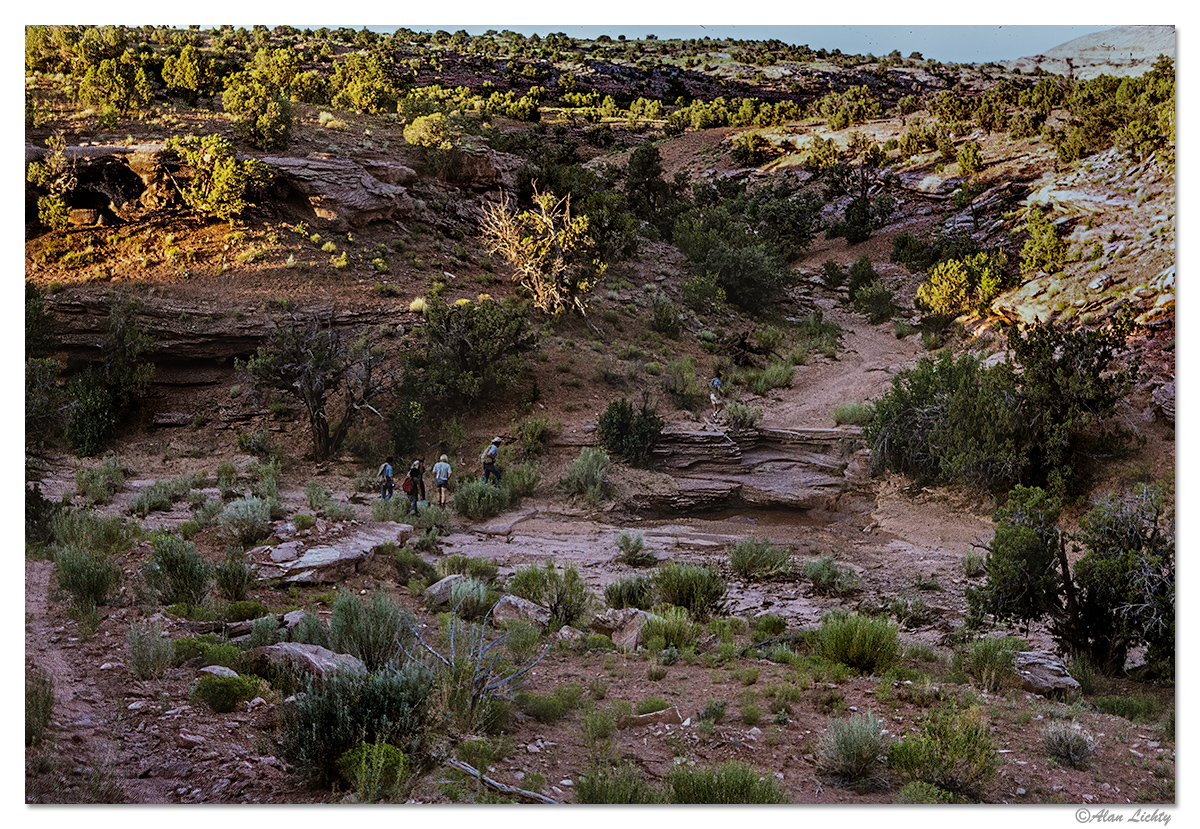
There is no road to the excavation site so we would drive several miles north from camp and then down some side roads where we would leave the vehicles and hike about a mile and a half through the washes to the caves. It took a couple of days for us to pack in all of the excavation tools and equipment that stayed at the site until we were done. Everybody carried something to and from the site daily as well.
The Site
Cowboy Cave is one of two dry cave sites in Southern Utah on one of the branches of Spur Fork. The name came from the fact that some cow puncher carved his name in the stone near the mouth of the cave sometime in the late 1800's. The second cave on the left in the image below is Walters Cave and although we did some sampling work on it we mostly worked on Cowboy Cave which was considerably larger (33m deep x 15m wide). The smaller cave was named for the Park Ranger at the Hans Flat Ranger Station at the time (Jim Walters).
When I say the cave was dry this is in the most absolute way. The earliest deposits within the cave at bedrock level had mixed dung layers from various Late Pleistocene herbivores carbon dated to 11,800 years ago. The cave showed human occupation starting roughly 8275 years ago with intermittent use up until about 1500 years ago. Water has never entered the cave so everything we found was completely intact from the Pleistocene dung layers up to the present. Cordage from the earliest human occupation at the site was so pliable you could still untie the knots. Yucca fiber sandals and stick figurines were equally pliable.

The images above and below were taken during an onsite photography workshop while we were leveling a tripod to take a panorama sequence of the scene with one of the 4x5's. The result of that was a darkroom stitched 5 panel panorama. We did another one inside of the cave using light painting with hand held flash units. Another part of the crew is surveying and mapping the mouth of the cave below.
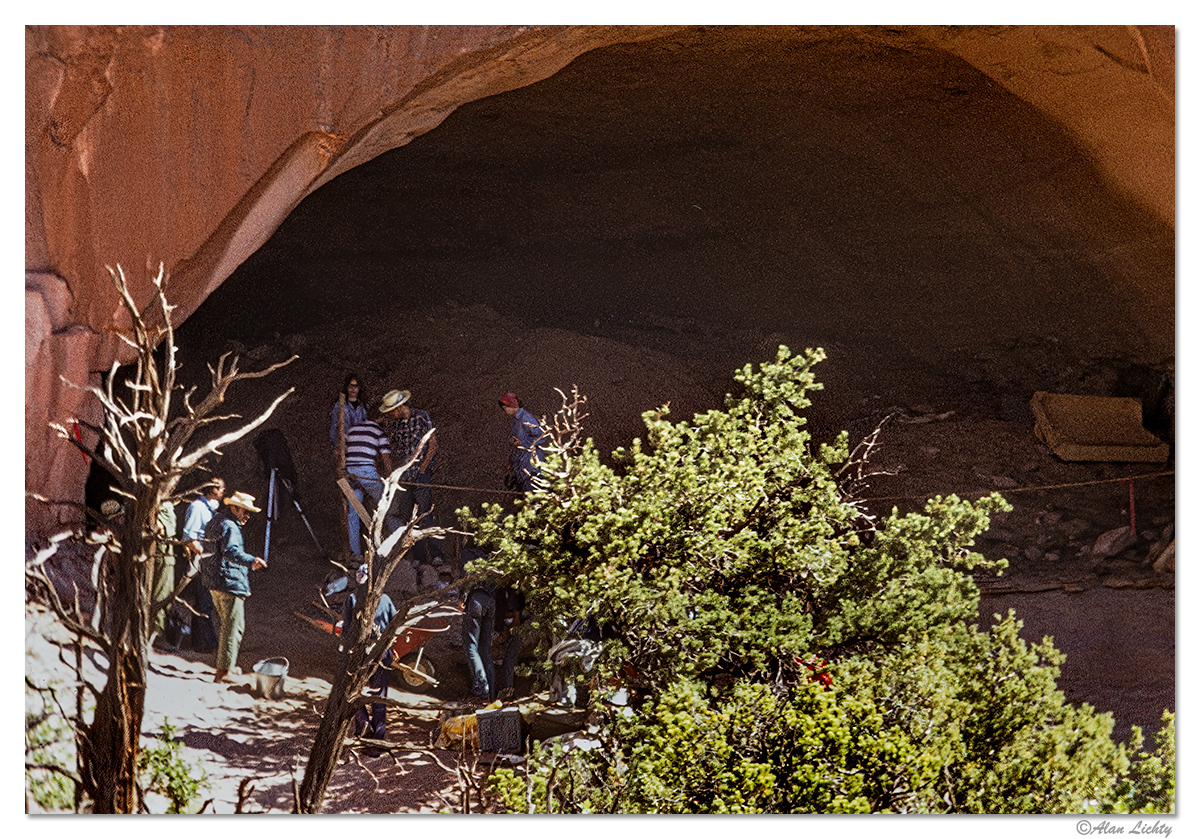
At one point during the excavation we had exposed part of the dung layers below the human occupation layers. We were visited by some paleontology specialists who worked with Late Pleistocene megafauna to get some help identifying what critters left the poo. Normally we excavate following the stratigraphy but in this case the paleontologists had us scrape through the dung deposits in 1cm increments looking for intact droppings. I found the biggest one - a 60cm meadow pie that turned out to be from a Pleistocene bison (Bison Antiquus) . We also found what was later identified as mammoth dung and some form of camelid. We found no conclusive evidence of human occupation in the deposits from the Late Pleistocene era. The dung layers are the brownish layers just above the sterile pink sand closest to the wheelbarrow handles in the shot below. The gray ashy layers above are from the human occupation layers. There is a pit that is visible right at the top of the corner where the sidewalls meet directly below the shovel handle in the back. Ashes from cooking fires were dumped into the pits along with layers of human coprolites and shredded juniper bark. This might be a bit on the TMI side but the turds were completely intact which allowed a lab to give us a complete breakdown of the inhabitants diet.
We shut down excavations to take photos the next morning after encountering a jawbone in the dung layers so I brought my SLR along and got some shots of the site in mid excavation. The jawbone was tentatively identified as coming from a Late Pleistocene relative of a modern camel.

This is a shot of the jawbone fragment getting its 4x5 B&W portrait.

Summer in Canyonlands
While you might think of spending a summer out in Canyonlands as a great opportunity to explore the region that was mostly limited to days off. After a day of physical labor moving a lot of dirt nobody had energy left for wandering much at all and usually trying to clean off some of the day's dirt and eating dinner was the only thought at hand. Evenings were usually spent going over excavation notes, labeling artifacts, and planning out what would be the next day's tasks at the site. Sunsets could be quite spectacular and when you are out there every day you will get to see some amazing ones. We were lucky that the summer in 1975 was actually wetter and cooler than usual. There were green meadows along the road between UT24 and Hans Flat and even Arches has green grassy meadows in early July.
I have posted several images of some of the sunsets we saw from Hans Flat as well as some of the day trips we took including Goblin Valley, The Maze, Barrier Canyon and Arches N.P. But have not posted anything from the excavations proper. Here are a couple of images from other threads I have done from that summer.
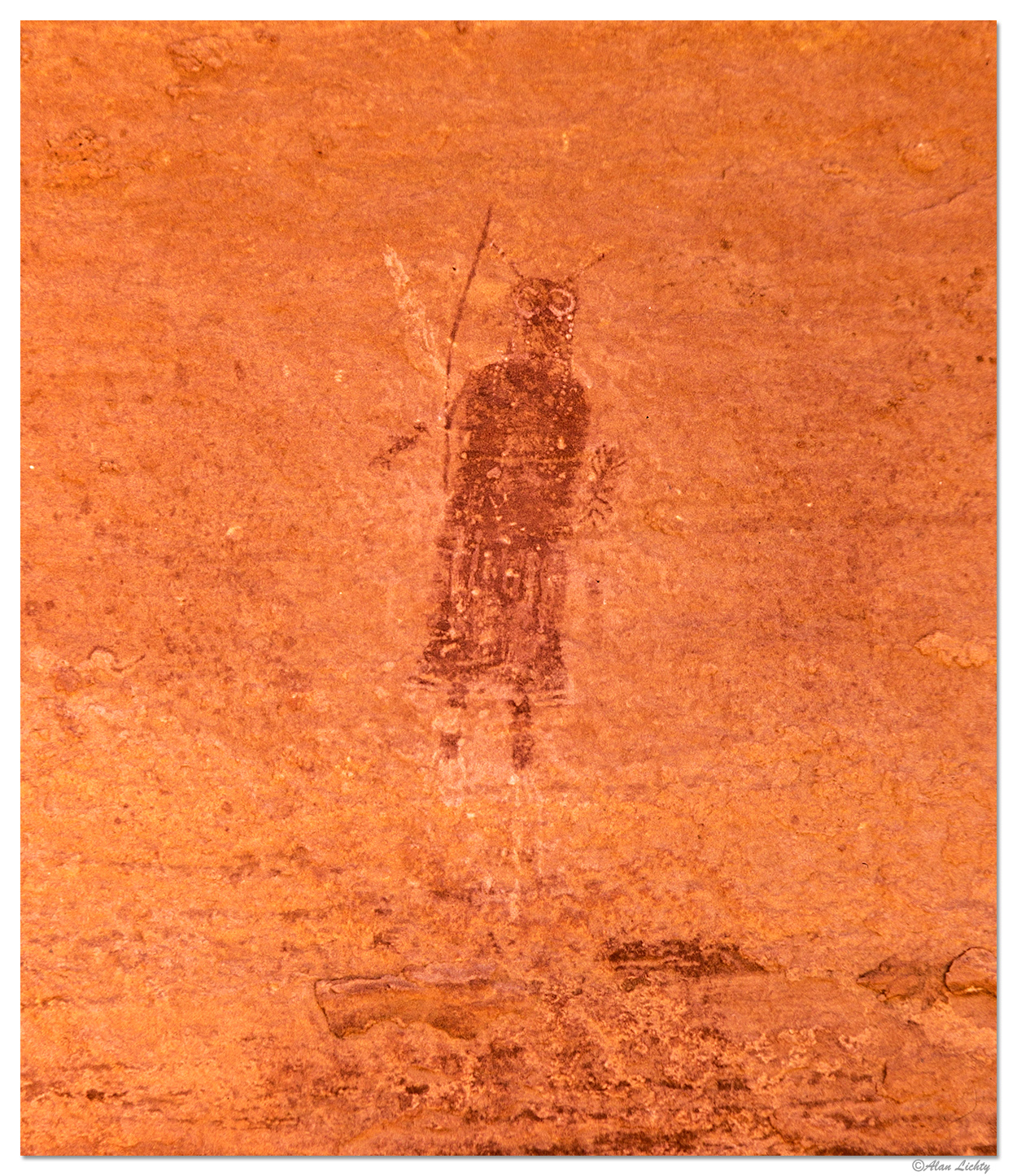
Rock Art in the Maze:
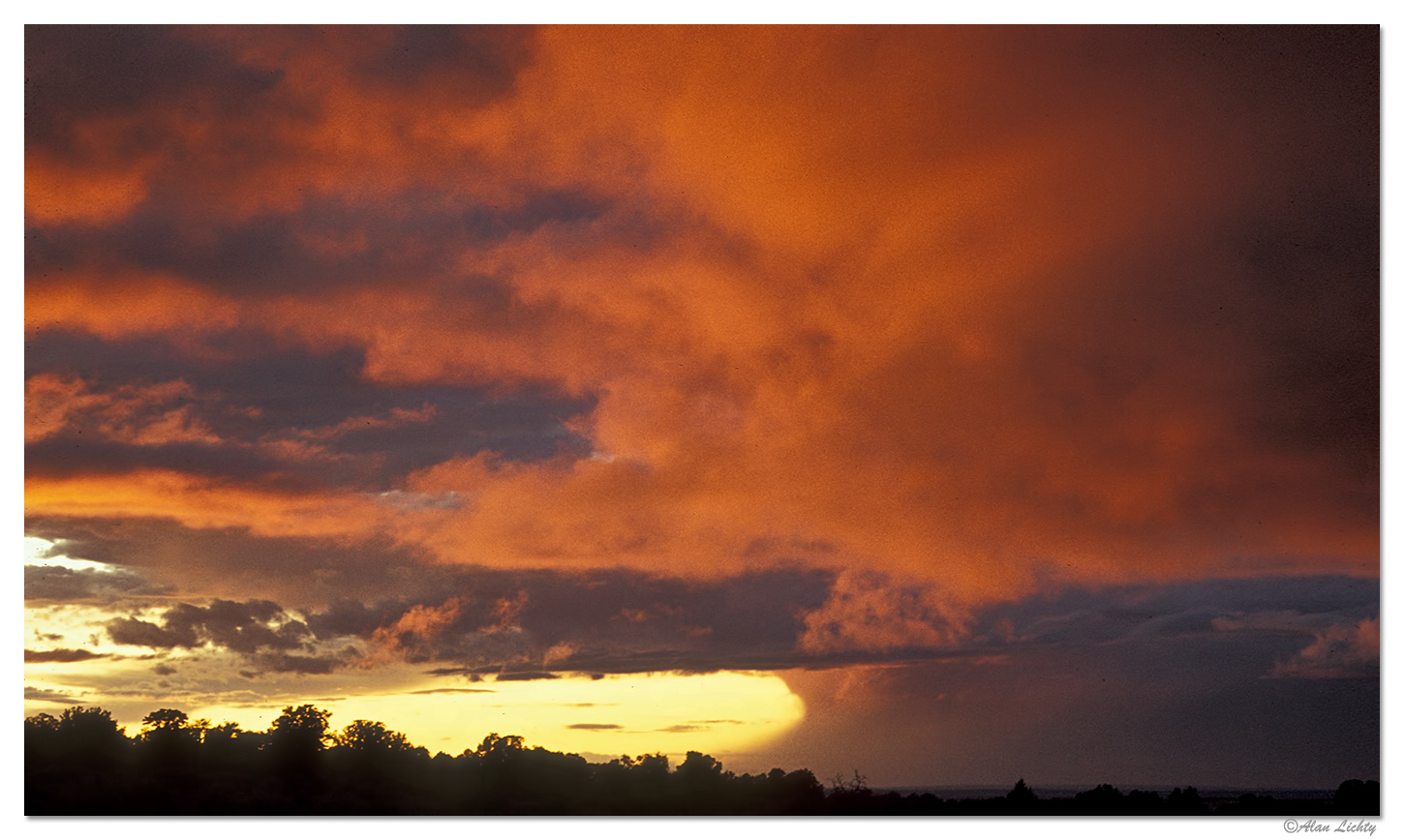
One of the sunset images as seen from our camp near Hans Flat:
Thanks for following along if you read through the whole adventure.
When I first went to graduate school with the Anthropology Department at the University of Utah I was told to sign. up. for. archaeological. field. school. if I wanted to work in archaeology. I had no clue exactly what to expect in terms of what we were going to do and where. It turned out to be a a very rare experience as excavations go. We got a one sheet handout describing that we should be prepared to live in tents for a couple of months.
The Camp
The location of our camp turned out to be a site nestled in the junipers about 1/4 mile north of the Hans Flat Ranger Station. We had 3 wall tents - one as our galley, a mess hall, and one for processing artifacts as well as acting as a classroom. We had a bunch of Springbar tents for our homes away from home. There were 16 of us - Jesse Jennings, a grad student assistant, a cook and 13 students. We had a couple of UofU motor pool vehicles and a small trailer that was used for provisioning runs twice a week to Green River. The trailer was filled with about a dozen 5 gallon gas cans so we could use vehicles while out at camp. Water was an issue - we had 3 55 gallon drums in the back of a Jeep pickup truck that got refilled several times per week from French Spring. Each of us was issued a 2 gallon Crazy Daisy dish pan and you would get 1.5 gallons/day which you could use for a splash bath. On a typical day when we started the trek back to the vehicles we looked like the typical shot of coal miners leaving the mines after their shift. We worked 6 day weeks followed by a day off to go into Green River to wash our clothes at the KOA, take a shower, and then migrate to Ray's Tavern for a cold beer and water with ice cubes.
We spent a few days setting up camp and attending workshops on various skills we were going to need including surveying and mapping skills along with photography fundamentals and photo techniques for recording excavation finds.
One important photo lesson - dirt and cameras. Dirt and film cameras are not good bedfellows and in the case of what we were about to experience fine airborne silts were going to exceed anything we had ever had to deal with. Archaeology is all about dirt. You are moving it all day long. All of the dirt is screened before it is dumped which just adds even more dust to the air. As it turned out all of the sand in the cave site we were about to dig in was airborne sand that had blown into the cave with the consistency of talcum powder. Just walking through the cave would raise dust that could linger for hours.
The Utah Archaeological Center had a resident photography specialist who was responsible for a fleet of cameras and knew how to clean and repair them. That fleet consisted of Pentax Spotmatic 35mm SLRs and several Graflex Graphic Speed 4x5 cameras. We were advised at the outset to leave our personal cameras back at camp most of the time or risk getting dirt in the mechanics of our cameras which could scratch the film. The excavation cameras were sent back to Salt Lake City every two weeks for a thorough cleaning and replaced with ones that had just been cleaned. In spite of the advance knowledge I can easily see scratches on quite a few of my slides from that summer. I wish we had done this in an era with smartphones so I could have taken far more images of what we were doing with less concerns about wrecking my film camera. As an archaeologist I took hundreds of photos recording excavation activities and finds but almost entirely with excavation cameras and not my own. I only took my camera to the excavation site 3 times during the 2 months we worked there - once the first day we hiked to the site, once when we cleaned up the site for some record photos and weren't actively digging, and once after the dig was completed.
The Commute
There is no road to the excavation site so we would drive several miles north from camp and then down some side roads where we would leave the vehicles and hike about a mile and a half through the washes to the caves. It took a couple of days for us to pack in all of the excavation tools and equipment that stayed at the site until we were done. Everybody carried something to and from the site daily as well.
The Site
Cowboy Cave is one of two dry cave sites in Southern Utah on one of the branches of Spur Fork. The name came from the fact that some cow puncher carved his name in the stone near the mouth of the cave sometime in the late 1800's. The second cave on the left in the image below is Walters Cave and although we did some sampling work on it we mostly worked on Cowboy Cave which was considerably larger (33m deep x 15m wide). The smaller cave was named for the Park Ranger at the Hans Flat Ranger Station at the time (Jim Walters).
When I say the cave was dry this is in the most absolute way. The earliest deposits within the cave at bedrock level had mixed dung layers from various Late Pleistocene herbivores carbon dated to 11,800 years ago. The cave showed human occupation starting roughly 8275 years ago with intermittent use up until about 1500 years ago. Water has never entered the cave so everything we found was completely intact from the Pleistocene dung layers up to the present. Cordage from the earliest human occupation at the site was so pliable you could still untie the knots. Yucca fiber sandals and stick figurines were equally pliable.
The images above and below were taken during an onsite photography workshop while we were leveling a tripod to take a panorama sequence of the scene with one of the 4x5's. The result of that was a darkroom stitched 5 panel panorama. We did another one inside of the cave using light painting with hand held flash units. Another part of the crew is surveying and mapping the mouth of the cave below.
At one point during the excavation we had exposed part of the dung layers below the human occupation layers. We were visited by some paleontology specialists who worked with Late Pleistocene megafauna to get some help identifying what critters left the poo. Normally we excavate following the stratigraphy but in this case the paleontologists had us scrape through the dung deposits in 1cm increments looking for intact droppings. I found the biggest one - a 60cm meadow pie that turned out to be from a Pleistocene bison (Bison Antiquus) . We also found what was later identified as mammoth dung and some form of camelid. We found no conclusive evidence of human occupation in the deposits from the Late Pleistocene era. The dung layers are the brownish layers just above the sterile pink sand closest to the wheelbarrow handles in the shot below. The gray ashy layers above are from the human occupation layers. There is a pit that is visible right at the top of the corner where the sidewalls meet directly below the shovel handle in the back. Ashes from cooking fires were dumped into the pits along with layers of human coprolites and shredded juniper bark. This might be a bit on the TMI side but the turds were completely intact which allowed a lab to give us a complete breakdown of the inhabitants diet.
We shut down excavations to take photos the next morning after encountering a jawbone in the dung layers so I brought my SLR along and got some shots of the site in mid excavation. The jawbone was tentatively identified as coming from a Late Pleistocene relative of a modern camel.
This is a shot of the jawbone fragment getting its 4x5 B&W portrait.
Summer in Canyonlands
While you might think of spending a summer out in Canyonlands as a great opportunity to explore the region that was mostly limited to days off. After a day of physical labor moving a lot of dirt nobody had energy left for wandering much at all and usually trying to clean off some of the day's dirt and eating dinner was the only thought at hand. Evenings were usually spent going over excavation notes, labeling artifacts, and planning out what would be the next day's tasks at the site. Sunsets could be quite spectacular and when you are out there every day you will get to see some amazing ones. We were lucky that the summer in 1975 was actually wetter and cooler than usual. There were green meadows along the road between UT24 and Hans Flat and even Arches has green grassy meadows in early July.
I have posted several images of some of the sunsets we saw from Hans Flat as well as some of the day trips we took including Goblin Valley, The Maze, Barrier Canyon and Arches N.P. But have not posted anything from the excavations proper. Here are a couple of images from other threads I have done from that summer.
Rock Art in the Maze:
One of the sunset images as seen from our camp near Hans Flat:
Thanks for following along if you read through the whole adventure.


