

@Bob Israel posted his awesome Aurora photos from up at Split Rock Lighthouse in Minnesota a week ago, I have been delayed as it is the grandkids spring break this last week and I was kept pretty busy. But finally I got one done.
The aurora was an amazing event, it's only my 2nd aurora, this one was much stronger then my first 2 years ago. While the colors were muted to the eye, I could literally see the sky dancing above me at some points. It was an amazing sight. I went up to Devil's Tower in Wyoming, which is about a 6 hour drive from my daughters house in Colorado. I pretty much had the place to myself. It was cold out, in the 20's, but also it's located up in the middle of no where really. I had I think 3 different people during the night drive up to the tower during the night, I had positioned myself on the road up to the tower in a spot that would let me aim to the north. At the parking lot area of the tower you are aiming to the east, and there are lot's of trees. I just didn't want to get in so close that the tower was blocking most of the sky.
2 of the people were using huge spot lights once they were up there to light up the tower. If you have done any kind of light painting at night, you know the last thing you want to use to light paint is a huge powerful light. You want to use soft low lights that are almost not visible to the eye. Fortunately they didn't ruin too many of my images. It was like they went up there, shined their lights for 5 or 10 minutes, and then drove back down. The aurora was so amazing I was surprised (but glad) that they weren't staying there all night long like I was. It was a sunset to sunrise show.
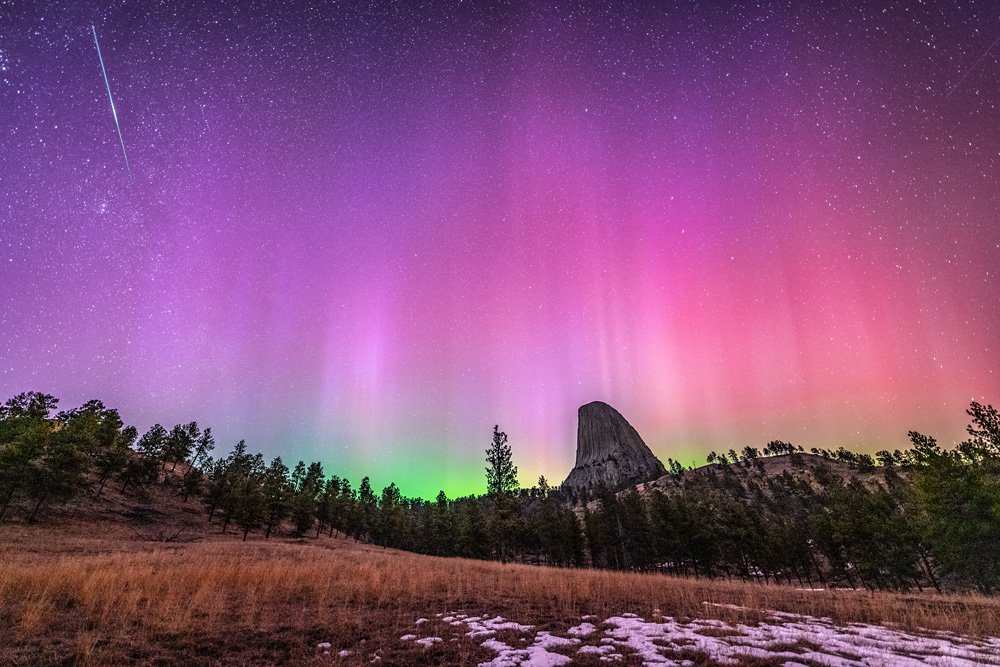
As I was reviewing my images I am using for the timelapses I will be creating, I found a couple of meteors during the night that photobombed the Aurora. There might have been more, I will have to look closer later, but I was happy with this really bright one that occurred in towards the beginning of the night.
This is from one of the 2 cameras I had put up in an open field that was up the hill from the pull out I was stopped at, it was maybe 1/4 mile from where I was parked.
The image is a single image, except for half of the meteor that was in the next frame (I imaged continuously throughout the night, with my cameras locked in with a Remote Release. And if you do any night time photography, it's really common for meteor's to be split between two frames. Not sure why that is, but it happens a lot with the longer meteor trails.
As to the exposure for those interested, My first aurora 2 years ago, I learned immediately that just using my normal night time Milky Way settings of ISO3200, 25 secs and f1.8 or f2.8 work perfectly. This year I knew from the reports it was brighter than that one 2 years ago, but even by eye, I could see how much brighter the sky was at night, there was a glow that was lighting up the ground. So I decided to shoot a little darker then I normally would at night, more of my full moon night time settings (though there was no moon). So for this I went with ISO2000, 20 secs and f1.8. And it looked perfect. That allowed me when it was brighter to pull down the exposure a bit in ACR when processing, and then when it did get darker later when the aurora wasn't as bright, I still had enough detail to brighten it without any noise issues or loss of detail.
Enough talking.... whew!
All comments are welcome,
Jim
The aurora was an amazing event, it's only my 2nd aurora, this one was much stronger then my first 2 years ago. While the colors were muted to the eye, I could literally see the sky dancing above me at some points. It was an amazing sight. I went up to Devil's Tower in Wyoming, which is about a 6 hour drive from my daughters house in Colorado. I pretty much had the place to myself. It was cold out, in the 20's, but also it's located up in the middle of no where really. I had I think 3 different people during the night drive up to the tower during the night, I had positioned myself on the road up to the tower in a spot that would let me aim to the north. At the parking lot area of the tower you are aiming to the east, and there are lot's of trees. I just didn't want to get in so close that the tower was blocking most of the sky.
2 of the people were using huge spot lights once they were up there to light up the tower. If you have done any kind of light painting at night, you know the last thing you want to use to light paint is a huge powerful light. You want to use soft low lights that are almost not visible to the eye. Fortunately they didn't ruin too many of my images. It was like they went up there, shined their lights for 5 or 10 minutes, and then drove back down. The aurora was so amazing I was surprised (but glad) that they weren't staying there all night long like I was. It was a sunset to sunrise show.
As I was reviewing my images I am using for the timelapses I will be creating, I found a couple of meteors during the night that photobombed the Aurora. There might have been more, I will have to look closer later, but I was happy with this really bright one that occurred in towards the beginning of the night.
This is from one of the 2 cameras I had put up in an open field that was up the hill from the pull out I was stopped at, it was maybe 1/4 mile from where I was parked.
The image is a single image, except for half of the meteor that was in the next frame (I imaged continuously throughout the night, with my cameras locked in with a Remote Release. And if you do any night time photography, it's really common for meteor's to be split between two frames. Not sure why that is, but it happens a lot with the longer meteor trails.
As to the exposure for those interested, My first aurora 2 years ago, I learned immediately that just using my normal night time Milky Way settings of ISO3200, 25 secs and f1.8 or f2.8 work perfectly. This year I knew from the reports it was brighter than that one 2 years ago, but even by eye, I could see how much brighter the sky was at night, there was a glow that was lighting up the ground. So I decided to shoot a little darker then I normally would at night, more of my full moon night time settings (though there was no moon). So for this I went with ISO2000, 20 secs and f1.8. And it looked perfect. That allowed me when it was brighter to pull down the exposure a bit in ACR when processing, and then when it did get darker later when the aurora wasn't as bright, I still had enough detail to brighten it without any noise issues or loss of detail.
Enough talking.... whew!
All comments are welcome,
Jim


